Study: Wind turbine output and low-level jets
S. Himmelstein | February 25, 2021The expansion of wind energy systems and the increasing height and size of wind turbines has turned the attention of design engineers to the effects of low-level jets on turbine performance.
These maxima in wind velocity occur in the lowest 50 m to 1,000 m of the atmospheric boundary layer and can enhance or undermine the output of wind turbines depending on how high the wind flows are in relation to the generators.
Researchers from the University of Twente in the Netherlands simulated the effects of low-level jets on a wind farm with a 4-by-10 grid of turbines. The scenarios modeled assumed these jets occurred above, below and in the middle of the turbine rotors.
With jets and the turbines at the same height, the front rows of the wind farm grid blocked wind access downstream, causing a reduction in power production in each successive row. Relative to this equal height scenario, a larger downstream energy capture was observed in both other cases, though by different mechanisms.
For high jets, the turbulence generated in the wakes of the turbines pulls the wind from the upper atmosphere down toward the turbines in a downward vertical kinetic energy entrainment process, leading to increased power production. The reverse process occurs when the jets are low as high-velocity wind from the jet is pushed upward into the turbine in a phenomenon labeled upward vertical kinetic energy entrainment.
The study and its implications for wind turbine performance and design are published in the Journal of Renewable and Sustainable Energy.
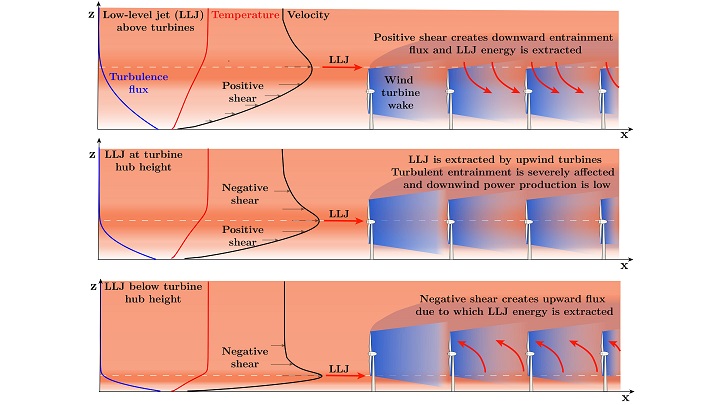 The amount of energy extracted from low-level jet flow is governed by whether wind turbines are operating below, at the same height or above the jet. Source: Srinidhi N. Gadde and Richard J.A.M. Stevens