Vegetable matter beefs up battery performance
S. Himmelstein | March 22, 2021Just as vegetables are an essential component of the human diet, they can also benefit lithium-ion battery engineering. An international research group has devised a recipe to 3D print battery electrodes derived from vegetable starch and carbon nanotubes, resulting in an environmentally sustainable and high capacity power source.
The performance of lithium-ion batteries can be undermined by the inclusion of thick electrodes, which restrict lithium-ion diffusion, limit the specific energy of the device and reduce strain-tolerance, making the battery more susceptible to cracking. A solution was sought by introducing nanoscale and microscale holes into the design to increase the surface area compared to a solid electrode of the same external dimension.
The researchers 3D printed porous electrodes using a material based on polylactic acid — a biodegradable material processed from the starch of corn, sugar cane and sugar beet — together with lithium-iron phosphate and carbon nanotubes. Different electrode thicknesses were tested, revealing a 300 micron electrode battery with 70% porosity to deliver the best performance with a specific capacity of 151 milliampere-hour (mAh) per gram. This is about two to three times the performance of a traditional lithium-ion battery with a solid electrode of the same thickness.
The increased porosity and greater surface area of this thick electrode also improved the areal capacity and was capable of storing 4.4 mAh/cm2 compared to 1.7 mAh/cm2 measured in a 100 micron electrode.
The research conducted by scientists from the University of Glasgow, Khalifa University of Science and Technology (United Arab Emirates), Texas A&M University and Arizona State University appears in the Journal of Power Sources.
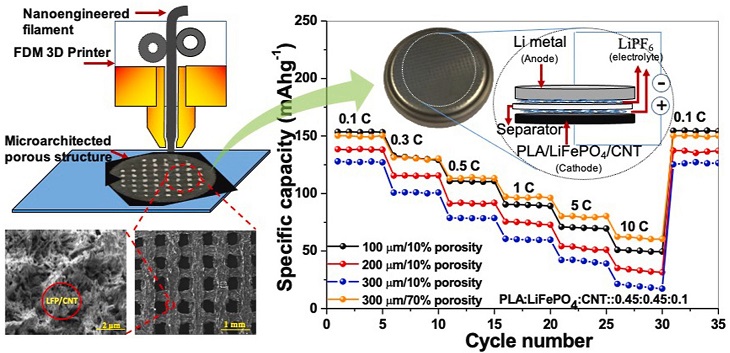 Electrodes of different thicknesses were composed of polylactic-acid, lithium-iron phosphate and carbon nanotubes. Source: S. Kumar et al.