Quantum computer testbed is open access
S. Himmelstein | March 19, 2021Realizing the potential of emerging quantum computer technology rests in large part on the ability to experiment with quantum machines that relatively few universities or companies have. The Quantum Scientific Computing Open User Testbed (QSCOUT) at U.S. Sandia National Laboratories is now available for researchers to use for this purpose.
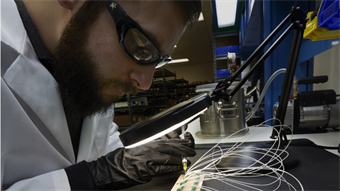
The free, open access testbed is engineered with trapped ion technology as a platform that gives users an uncommon amount of control over their research. Researchers from IBM, U.S. Oak Ridge National Laboratory, the University of New Mexico and the University of California Berkeley have been selected to  Source: U.S. Sandia National Laboratoriesbegin experiments soon. Projects range from testing benchmarking techniques to developing algorithms that could someday solve problems in chemistry too complex for current computer systems.
Trapped ions are contained inside QSCOUT in a so-called trap on a chip, a flat, bow tie-shaped device, about 2 cm (0.8 in) long, overlaid on a semiconductor chip. Three electrically charged atoms of the element ytterbium are suspended in place by radio waves and an electric field above a hairline channel that runs down the center of the device. Lasers encode information in each ion as a qubit, comparable to a bit in a conventional computer, to perform calculations.
The testbed design eliminates the use of superconducting circuits, which must be maintained at ultralow temperatures, making them expensive to build and operate. The ion trap technology incorporated into QSCOUT enables operation at warmer temperatures and yields clearer signals than circuits.
The system will be expanded from three to 32 qubits over the next three years so scientists can perform more sophisticated tests.