
Examining three-phase transformer corrections
Ahmed Faizan Ahmed | March 17, 2021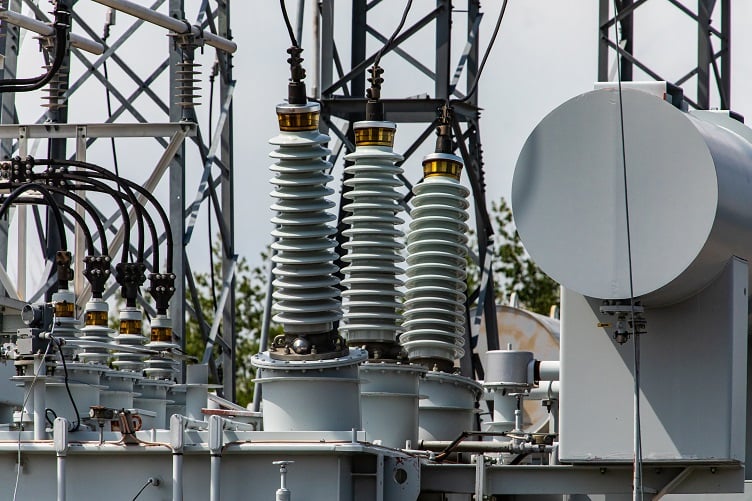 Three-phase transformers can be connected in delta-delta, delta-wye, wye-wye, and wye-delta configurations. Source: AdobeStock
Transformers may be connected in various configurations depending on the application. Configurations consist of 1φ and 3φ connections. Single-phase connections are typically found in residential applications, while 3φ connections are found in commercial and industrial applications.
When there are dual windings, each phase of a 3φ transformer can have its windings connected in series or in parallel. The procedure for connecting a 3φ transformer is the same as the procedure for connecting a 1φ transformer. The phase windings of each phase are connected in either a wye (Y) or a delta (Δ) configuration, in the same manner as that for a 3φ generator.
A wye configuration is a transformer connection that has one end of each transformer coil connected. The remaining end of each coil is connected to the incoming power lines (primary side) or used to supply power to the load(s) (secondary side). A delta configuration is a transformer connection that has each transformer coil connected end‐to‐end to form a closed loop. Each connecting point is connected to the incoming power lines or used to supply power to the load(s). The voltage output and type available for the load(s) is determined by whether the transformer is connected in a wye or delta configuration.
Three-phase transformers can be connected in delta-delta, delta-wye, wye-wye and wye-delta configurations. One primary and one secondary lead of the same polarity are marked with a white polarity mark. It is important that the polarity is observed when making these connections because improper connections can generate undesirable voltages.
When three-phase windings are connected in a delta configuration, the line voltage is equal to the phase voltage. The line voltage of a 3φ transformer connected in a delta configuration is calculated by applying the following formula:
Vφ = VLINE
Where
Vφ = phase voltage (in V)
VLINE = line voltage (in V)
Example: What is the phase voltage of a delta-connected 3φ transformer that has a line voltage of 230 V?
Vφ = VLINE
Vφ = 230 V
For delta-connected transformers with a balanced load, the line current is calculated by applying the following formula:
ILINE = 1.73 × Iφ
Where
ILINE = line current (in A)
1.73 = constant
Iφ = phase current (in A)
Example: What is the line current of a delta-connected 3φ transformer with a phase current of 15 A?
ILINE = 1.73 × Iφ
ILINE = 1.73 × 15 A
ILINE = 25.9 A
When the 3φ windings are connected in a wye configuration, the value of the line voltage is calculated by applying the following formula:
VLINE = 1.73 × Vφ
Where
VLINE = line voltage (in V)
1.73 = constant
Vφ = phase voltage (in V)
Example: What is the line voltage of a wye-connected, 3φ transformer with a phase voltage of 240 V?
VLINE = 1.73 × Vφ
VLINE = 1.73 × 240 V
VLINE = 415.2 V
When working with wye-connected transformers, the transformer line current is equal to phase current because the line and phase windings are connected in series with each other. Phase current in a wye-connected transformer is calculated by applying the following formula:
Iφ = ILINE
Where
Iφ = phase current (in A)
ILINE = line current (in A)
Example: What is the phase current of a wye-connected 3φ trans-former that has a line current of 15 A?
Iφ = ILINE
Iφ = 15 A
These equations can be applied to systems that use three separate 1φ transformers with dual primary and secondary windings. Primary windings are rated at 600 V, and secondary windings are rated at 120 V. As with a 1φ transformer, the method in which 3φ transformers are connected is determined by the amount of source voltage and voltage requirements of the load.
For example, 120 V load requirements are met by center-tapping one of the secondary phases. There is 120 V present between Bφ and neutral and between Cφ and neutral. Only one phase can be used to obtain this voltage. A short circuit will develop between phases if another phase has its center tap connected to the ground.
There are 240 V present between phases A-B, B-C and C-A. It is difficult to balance the current load with delta secondary windings where the load requires two values of voltages. The main advantage of delta connections is that if one phase is lost, 3φ power is still available to the load, although with a reduced kVA rating to all three phases. Phase current equals line current, and the 1.73 multiplier advantage has been lost.
If primary windings are connected in the parallel delta so that the 600 V line voltage is impressed across each primary winding and the secondary windings are connected in a parallel wye configuration, the connection provides 120 V to the neutral for each phase. Between phases, the voltage is equal to 207 V (120 V × 1.73). The advantage of having the secondary winding in a parallel-connected wye configuration is that 120 V can be obtained from all phases. This makes it easier to balance the load on the transformer. The biggest disadvantage of a parallel-connected wye configuration is that 3φ power is lost if any phase fails.



