
Porsche 3D prints a complete electric drive unit housing
S. Himmelstein | December 29, 2020Porsche has produced its first complete housing for an electric drive unit using 3D printing, resulting in an engine-gearbox unit that passed all quality and stress tests.
The additively manufactured alloy housing reduces the overall weight of the drive by about 10% compared with a conventionally cast part and features increased stiffness in highly stressed areas. Composed of an integrated two-stage transition and a motor, the 3D printed housing is designed for use on the front axle of a sports car. 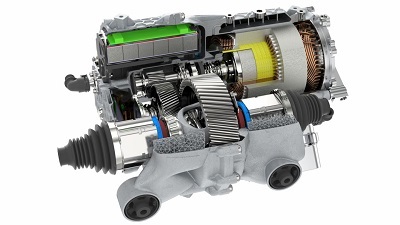 The E-drive housing was 3D printed. Source: PorscheIntegrated within the housing is a permanent magnet motor capable of delivering 280 hp, and a downstream two-stage transmission to drive the wheels with up to 2,100 Nm of torque.
The proof of concept E-drive housing was fabricated by selective laser melting technology in 21 hours. The housing was printed with lattice structures in order to optimize topology of the part and reduce its weight, and the technology was demonstrated to enable the functional integration of cooling channels. Despite a continuous wall thickness of only 1.5 mm, the stiffness between the electric motor and the gearbox was increased by 100% due to the lattice structures. The honeycomb structure reduces the oscillations of the thin housing walls and thus considerably improves the acoustics of the drive.
The integration of parts made the drive unit more compact, significantly improved the drive package and reduced the assembly work by around 40 work steps.




The ability to quickly manufacture complex machines and large structures via this method will greatly accelerate the development of off world facilities.
I keep hearing about how 3D printing can make better parts requiring less secondary work or assembly but the time to produce a single part seems to be too long for anything more than niche or low volume products.
The 21 hours used for this one housing is a production rate of 1 car per day per 3D printing machine.
In reply to #2
The real strength here is to produce a prototype or low production parts very quickly and at less cost than producing a all the tooling needed for a cast part. The production time of a traditionally manufactured part becomes much greater when you add in time to procure tooling. You are right though, high volume production is not suited for most DED options yet.
There is a great deal of interest in using binder jetting options however, and with some recent improvements this system could reach production level cycle times. Binder jetting moves the sintering and heat treatment processes outside of the 3D printer allowing the printer to focus on printing. Once done multiple parts can be processed all at once in large furnaces while the printer continues on to the next batch. This all relies on strong additive designs as well, simply dropping a traditional design in a additive system is not efficient, and in a high performance low volume application such as a Porsche the 10% weight savings may be deemed a priority.
Additive is not a silver bullet but it is a powerful tool that needs to be further developed.