Microbial fuel cell improves wastewater treatment sustainability
S. Himmelstein | December 22, 2020The energy intensity of wastewater treatment can be reduced with a coincident improvement in sustainability by use of microbial muscle. A microbial fuel cell system engineered y researchers from Washington State University and University of Idaho fulfills these roles by generating electricity for the treatment process and eliminating the need for external aeration.
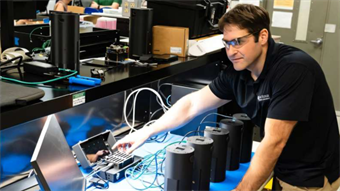
The dual mode bioelectrochemical wastewater treatment scheme combines microbial fuel cells with polarized  A bioelectrochemical wastewater treatment system was tested at the pilot scale. Source: Washington State Universityelectrodes. Inclusion of an extra electrode improves treatment system control and enables operation of the microbial machine as a fuel cell to slowly treat wastewater at little energy cost. The electrodes can also be manipulated to support a more intensive purification proves that consumes less energy relative to conventional aeration processes.
Operation of the system for one year in a pilot-scale test facility with 16 anode and cathode pairs demonstrated wastewater treatment efficiencies comparable to those achieved with aeration. The researchers envision use of this biotechnology to enable off-grid operation of small-scale wastewater treatment plants.