Manufacturing hydrogen in microbial factories
S. Himmelstein | December 17, 2020A microbial route to hydrogen fuel production has been demonstrated by researchers from Harbin Institute of Technology, China, and University of Bristol, U.K. The approach used sugary droplets packed with algal cells to generate hydrogen rather than oxygen as is normally generated by photosynthesis.
Chlorella algal cells assembled into the droplets as microscale reactors by osmotic compression maintained 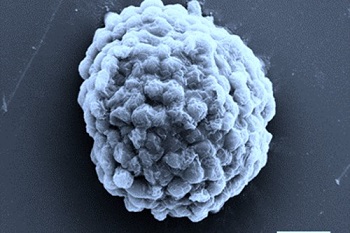 Electron microscopy image of a densely packed droplet of hydrogen-producing algal cells. Source: Xin Huang et al.depleted oxygen levels, prompting production of hydrogenase enzymes, which direct photosynthetic pathways to produce hydrogen. Coating the micro-reactors with a thin shell of Escherichia coli bacteria, which scavenge for oxygen and therefore increase the number of algal cells, further increases hydrogen output.
The demonstration of hypoxic photosynthesis at room temperature in air could lead to a sustainable method for promoting photobiological green energy development under natural aerobic conditions. The methodology for spatially controlling different types of cells might also provide biomedical benefits in terms of cell therapy and tissue engineering.
A paper on this research is published in Nature Communications.