Team devises new bone implant manufacturing process
Marie Donlon | November 16, 2020A team of scientists from Russia’s Skoltech Center for Design, Manufacturing and Materials (CDMM) has devised a 3D printing process for creating complicated ceramic bone implants with porous structures that encourage more efficient tissue fusion.
Because ceramic material is resistant to chemicals, wear and mechanical stress, the CDMM team determined the material would be ideal for custom bone implants. Further, the team also determined that 3D printing would enable the creation of custom porous structures on the material, thereby encouraging more efficient tissue fusion via a functional representation (FRep) method.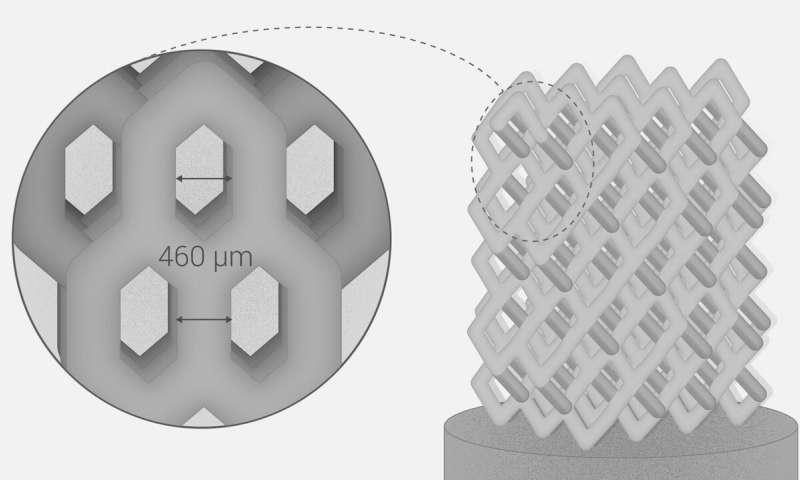 Source: Pavel Odinev/Skoltech
"FRep modeling of microstructures has a wealth of advantages," explained Skoltech researcher and paper coauthor Evgenii Maltsev. "First, FRep modeling always guarantees that the resulting model is correct, as opposed to the traditional polygonal representation in CAD systems where models are likely to have cracks or disjointed facets. Second, it ensures complete parametrization of the resulting microstructures and, therefore, high flexibility in the fast generation of variable 3-D models. Third, it offers a diversity of tools for modeling various mesh structures."
According to the Skoltech team, the FRep method was employed to design cylindrical implants along with a cubic diamond cell to model the cellular microstructure of the implant, which was then 3D-printed via CDMM's Additive Manufacturing Lab. This method enabled the team to alter the porous composition of the material to result in implants with different densities according to a patients' particular needs.
The research appears in the journal Applied Sciences.