Mayday! Tech that saves lives during in-flight emergencies
Timothy John Estrella | August 25, 2020
Make no mistake: when it comes to safety, air travel is proven as the safest mode of transportation. According to U.S. Department of Transportation statistics, when it comes to the number of annual fatal accidents per volume of passengers, air travel has the fewest passenger deaths.
And aircraft do not just fall out of the sky. The industry has implemented design and procedure redundancies to minimize potential for fatal mistakes. One defining trait the industry has that separates it from the other modes of transportation is that it is keen to investigate and correct, at a global level, any flaw it finds either in the aircraft design or in human performance.
Nonetheless, large plane crashes capture much attention, in part because they are so rare. Lesser known are the flights saved by auxiliary systems and mechanical redundancies. And when something in air does go wrong, these are the technologies that kick in.
Managing engine loss
In any multi-engine aircraft, a loss in a single engine’s power does not doom the flight to catastrophe.
The design of the airplane with a multiple engine allows the aircraft to continually fly until it lands to the nearest airport. This is possible as a one jet engine alone can provide thrust to keep the aircraft aloft, even if the opposite engine shuts down.
This is called the RTO (reserve take off) power which automatically increases the jet engine power once the opposite engine shuts down after takeoff.
The engineering design behind this capability is possible through the system computers. In this situation, a computer called engine electronic control (EEC), which is installed on each engine and communicates between each units, will automatically increase the fuel supply to the remaining engine once it detects that the opposite engine and its EEC are inoperative.
This taps into RTO, which is typically the maximum rated power output of the engine. In non-emergency situations, an aircraft engine operates below this threshold for the sake of fuel consumption and maintenance. RTO is also sometimes used to help planes take off with heavy loads or on short runways.
The aviation industry also rates aircraft based on extended duration flights. Engines for long duration and transoceanic flights are sometimes extended-range, twin-engine operational performance standards (ETOPS) rated. ETOPS engines are constructed with extreme care and additional system redundancies, nearly guaranteeing the engine will not fail during flight. Aircraft are then rated based on their ability to safely deliver the aircraft with only one ETOPS engine. A plane with an ETOPS 180 rating can continue to fly for 180 minutes on its remaining engine. These ratings then help airlines schedule flight plans that account for ETOPS operations.
Whereas ETOPS is more prevalent in North America, extended diversion time operation (EDTO) is the common metric in Europe. This requires that all public transport aircraft of at least two engines have extended single-engine operation ratings of 60 or 180 minutes, which should provide sufficient time to land at a diversion airfield.
Preventing stall
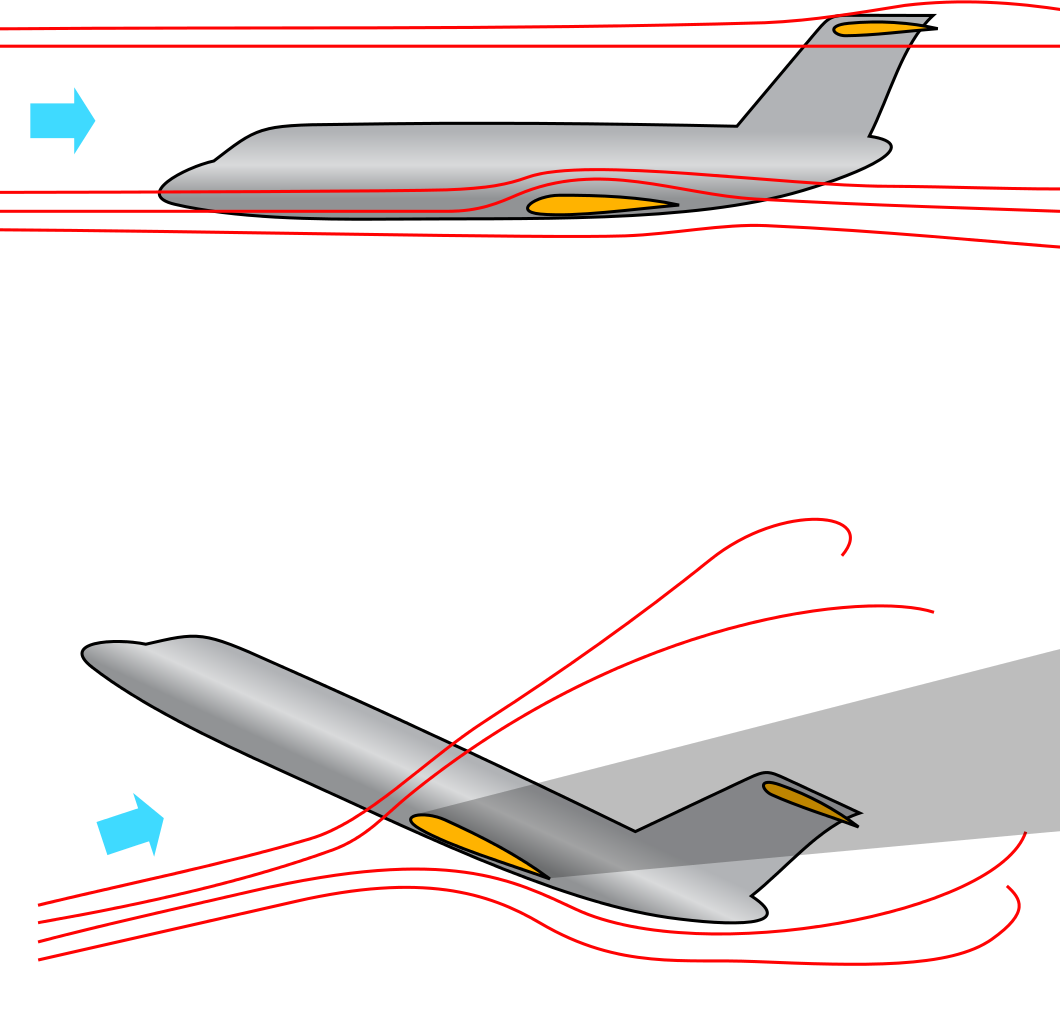 Diagram of typical lift versus stall airflow.
In the simplest terms, the airspeed of the wings of an aircraft must be sufficient enough to produce enough lift to overcome gravity. When that airspeed falls below a certain point, so does the plane.
On large, advanced aircraft, this situation is avoided by a combination of technology and protocol. Sensors are strategically located near the radome/nose area of the aircraft skin. One of these is called a pitot tube, which reads the speed of the aircraft; another is known as the alpha vane which detects the vertical angle position of the whole aircraft. Together, these sensors transmit information to an onboard computer that warns the pilot if the airplane if a stall is about to happen.
Inside the cockpit, various "attentions getters" of emitting visual and aural alerts. The flight crew is bombarded by maximum red lights and chimes, and they must respond by increasing engine power and easing the aircraft downward. The stall may feel like a crash is about to occur - a feeling of weightlessness followed by rapid decent – but if executed correctly the plane will definitely recover.
If the pilot does not respond to the emergency cues, onboard computers will command an electrical actuator located below the cockpit to override the pilots control and automatically point the nose of the aircraft downward to help in accumulating enough airspeed. This electrical actuator would produce enough force that even the strongest pilot cannot override.
Compromised cabin atmosphere
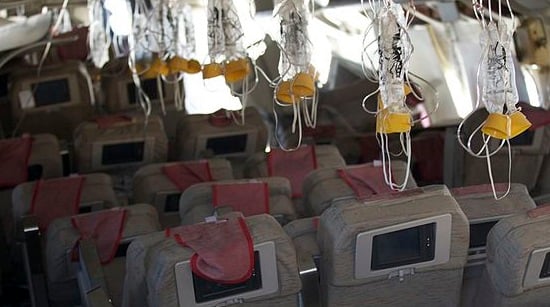 Emergency masks deployed in a plane cabin.
In an emergency situation where the airtight seal of the aircraft has been compromised the aircraft will attempt to land at the nearest airport. This can happen from an explosion on board, puncture in the aircraft envelope, or if a gas or smoke is present in the cockpit or cabin, the flight crew is advised to land immediately.
If an aircraft has lost pressurization, the passengers and flight crew would be exposed to the oxygen levels of the plane’s altitude. Altitudes greater than 10,000 ft have insufficient oxygen, and the aircraft can supply emergency air supplies for passengers and crew.
Inside the cockpit, the flight crew is supplied by an aviation-grade oxygen cylinder which can be rated for 1,850 psi or more. It can supply pure oxygen to the flight crew regardless of the situation. The oxygen coming from the supply cylinder would pass through a pressure regulator to decrease pressure to a level safe human consumption, likely around 70 psi. The oxygen mask used by the flight crew is designed with an inflatable harness which would adjust to the shape of the head of the pilot. This ensures that the mask is tightly fitted to the face of the pilot, even if the aircraft is inverted.
In the cabin, a simpler emergency oxygen mask is located inside the passenger service unit (PSU) above each row of seats. This oxygen mask, depending on the aircraft type can be deployed in three different ways. It will deploy once the cabin pressure sensor detects that the cabin air pressure is equivalent to above 10,000 ft. The masks can ales be deployed through a push button located above the pilot’s seat. Finally, a special tool kept by the cabin crew permits them to deploy the masks if necessary.
Unlike the flight crew’s oxygen supply, the passenger oxygen is chemically generated through a canister connected to the oxygen mask. This chemical would only start to activate once the oxygen masks have been pulled down with enough force for the trigger to start the chemical reaction. Another limitation in this design is that the canisters can only supply oxygen for a total of 15 minutes. This is why pilots are required to land immediately, as the passenger oxygen supply is only limited.
For the cabin crew, they are provided with a portable oxygen bottle that can supply them for 30 minutes. The portability ensures that they can still be mobile to attend to emergency situations without losing oxygen supply.
Flame suppression
The fire protection system of the aircraft allows the flight crew to detect fire in its preliminary stages, thanks to different sensors depending on the location where the chances of fire are highly probable.
For engine fire detection, it is designed with a dual loop sensor wherein there are two sensing elements, called Loop A and Loop B, that detect fire whenever there is an increase in resistance and decrease in capacitance. These detectors send a signal to an onboard computer usually called a fire detection control unit (FDCU) and helps to activate the Fire Extinguisher allotted to each engine by button control from the cockpit.
For misbehaving passengers who sneak a cigarette inside the lavatory, there is an ionization type smoke detector. Near the lavatory trash bin, an automatic fire extinguisher activates once it has detected around 77° C. This is specifically designed to combat any cigarette butts thrown inside the trash bin that can ignite tissue or any other combustible material. The lavatory area is the only location inside the aircraft equipped with an automatic fire extinguisher.
Inside the cargo compartments, there are photoelectric type smoke detectors that detect any smoke in its preliminary stage. A fixed fire extinguisher located inside the cargo compartment can be used by the flight crew to extinguish the fire. Inside the cabin and cockpit, there are additional portable fire extinguishers that are used to extinguish any fire coming from the overhead storage bin or galley area.
Hijacking
In the case of any attempt to hijack the aircraft, a bulletproof cockpit door can foil most intrusion attempts and remains locked via a magnetic locking mechanism. The door can be unlocked with keypad panel, and by a pilot who identifies the entrant via mounted night vision cameras.
Rough landing
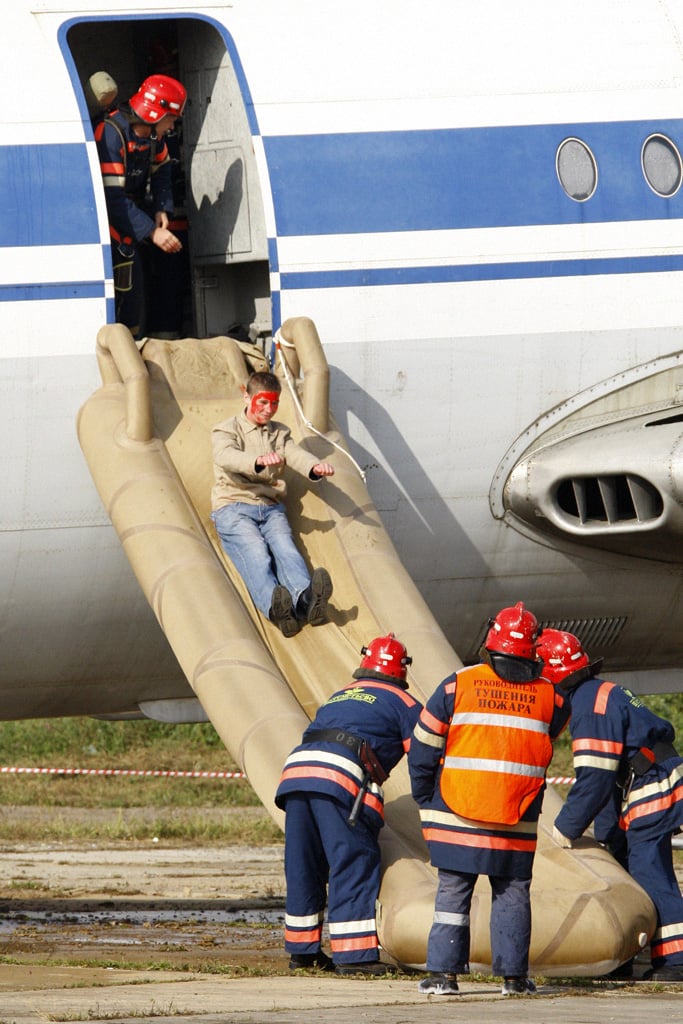 Emergency slide. Source: Anton Denisov/CC BY-SA 3.0
If a water landing is unavoidable, the flight crew should close all valves located in the belly position of the aircraft to avoid water filling the fuselage at a faster rate. These valves are closed by push button control that causes the valves to be de-energized and closed.
Before any passengers jump out of the aircraft, it is important to remember the life vest located below their seat. It is important to keep these vest deflated until leaving the aircraft. An inflated life vest makes egress more difficult and is more likely to tear. It will also trap passengers still inside a plane if it starts to sink. These vests feature a light that makes it easier to find survivors in the dark.
If a passenger is ready to deplane in an emergency situation, he or she will likely need to take the inflatable slide or raft out the plane door. Both are stored in cavities in the airframe and can deploy in seconds due to an integrated nitrogen canister.
Reassurance
Thorough and precise engineering have provided aviation’s exceptional safety record. Even though there is a small probability of needed these technologies, it is reassuring to know they are there, waiting to be called on.