Fundamentals of airliner electrical systems
Timothy John Estrella | May 11, 2021 Source: NYC Aviation/ CC BY-ND 4.0
A modern jetliner can feature hundreds of miles of wire and cabling run throughout its plenum spaces and raceways. Today, aircraft are increasing automated with various technologies and sensors located throughout the aircraft. This ultimately creates a safer flight experience.
It also supplies much needed power to passengers increasingly looking to use personal electronics throughout a flight. That might mean connecting to the office to get a few hours of work done; or streaming a movie or game to pass time. Suddenly the overall electrical demand of the aircraft is a couple hundred users, dozens of systems and many, many devices.
It is extremely rare that an electrical failure results in an airplane crash. And it's amazing that aircraft are able to supply this much power on long flights.
Here's how.
The engine does all
As with an automobile, the majority of electricity on an aircraft is generated by an alternator that is mechanically linked to the engine. Inside the engine is a drive shaft connecting the compressor section to an auxiliary gear box (AGB) that drives a generator to create electricity.
The AGB is highly efficient, but it does also incur a fuel consumption penalty to the engine. Ground engineers regularly inspect the AGB to ensure that there is sufficient oil quantity to provide lubrication and minimize the friction of internal components, so it generates the most possible power.
The output of the alternator is often 28 V DC to power the DC systems and components of the aircraft. Rectifiers will change the voltage in 115/230 V AC for things like passenger outlets.
This process is continuous and available as soon as the aircraft engine is operative, even when the aircraft is on the ground. The electricity produced is enough to provide electricity for the whole aircraft.
Electrical generation is also redundant. Each engine can typically supply enough power for the whole aircraft. For example, the Airbus A320's engines can supply over 150 kW but it typically only needs 50 kW to operate. This also provides some scalability for potential future equipment additions.
Even if the electric supply from all engines fails, a modern airliner typically features three auxiliary systems that can supply the needed power, so the aircraft can at least make a safe emergency landing.
Backup no. 1: Auxiliary power unit
 An APU unit exposed. Source: YssYguy/CC BY-SA 4.0Considered the primary electrical backup source, the auxiliary power unit (APU) is a gas turbine engine, just like those under the wings, but typically located at the rear of the fuselage on medium sized passenger aircraft and larger. This is a gas turbine with two primary jobs: provide electrical power for aircraft controls, cabin lighting and other mission critical systems; and also provide compressed air to systems around the plane.
APUs run on a fuel that is less expensive than jet fuel, which saves some fuel costs and engine wear on the main aircraft turbines. They are commonly run when the plane is taking on or discharging passengers. They are often turned off during takeoff but might be re-engaged once the plane reaches a cruising altitude, depending on power needs. Since APUs provide no thrust, they are not considered an engine.
The pneumatics supplied by the APU is bleed air, which is basically the compressed air inside the engine that has been redirected into a duct and distributed throughout the aircraft. This design eliminates the need for additional equipment such as air compressors, which results in the optimal utilization of the APU. This can be used as initial starting pressure to spin the main engine turbine blades up to speed before they are started. It is also used to pressurize the HVAC system.
Backup no. 2: Ram air turbine
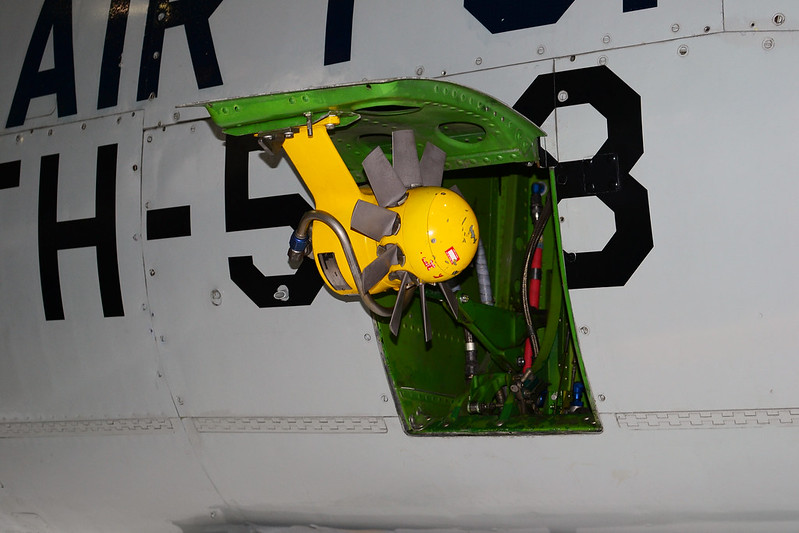 A ram air turbine deployed on the ground. Source: Ian Abbott/CC BY-SA 2.0In an emergency where both the engines and APU fail to deliver enough power, the flight crew has another tool to deploy: the ram air turbine.
The ram air turbine is essential a wind turbine that folds down from the fuselage and utilizes the forward speed of the aircraft to move air over the blades, which is then converted into electricity. This then powers mission critical electrical and electronic devices, such as avionics, cabin lighting and landing gear. Some ram air turbines may only generate hydraulic pressure, which can then be converted into electricity.
The ram air turbine is an emergency-only device, unlike the APU. Most flight regulatory bodies require reporting if the ram air turbine is deployed during flight, even inadvertently. A ram air turbine adds a lot of drag to the airplane as well. Most aircraft must be flying at speeds no less than 130 knots or 240 km/h to be able to generate enough electricity without stalling.
Backup no. 3: Battery power
There is a final line of defense, should an airplane lose its engine electricity, APU and ram air turbine - battery reserve. Two, actually.
The main battery typically helps the APU startup, which in turns helps start the main aircraft engines. It also provides some power for functions that might be needed more impromptu, such as refueling indicators or braking should the aircraft need to be towed while idle. Some aircraft may feature two main batteries, with one dedicated solely to engine startup. Once the alternators on the engines start to run, a main battery can be recharged.
The emergency battery stores power for in-flight emergencies, and will power flight controls and essential systems for 15 minutes to 20 minutes - enough to ensure the safest possible landing given the dire situation at hand.
Airliner batteries are typically nickel-cadmium or lead-acid in construction. Both main and emergency batteries are meant to be short duration, high discharge power supplies. Main batteries often supply 10 Ah to 50 Ah; emergency batteries may supply just 1 Ah to 10 Ah. To ensure the reliability of the batteries, they are frequently tested every 400 flying hours, or as suggested by its manufacturer.
Summary
The four sources of electrical supply for an in-flight aircraft have made electrical flight hazards very rare. But they do occur, and thankfully brilliant aerospace engineers have provided great solutions.
But the aerospace industry is facing a potential sea change (or should it be atmosphere change?). Aircraft are another vehicle that is becoming more and more electrified. And right now the biggest challenge for engineers is delivering the power density needed for sustainable, safe electric flight in a reliable and lightweight package.