
Chemists turning bricks into energy storing devices
Marie Donlon | August 12, 2020Chemists from St Louis’ Washington University are turning bricks into energy storage devices.
To transform the red brick from a commonly used building material used in the construction industry into supercapacitors to charge devices, the chemists applied a coating to the brick of the conducting polymer PEDOT, which is composed of nanofibers capable of penetrating brick.
Once the coating penetrates the brick, it operates like an ion sponge inside of the brick, storing and conducting electricity. Meanwhile, the pigment that gives the bricks their red hue — iron oxide (or rust) — causes a polymerization reaction.
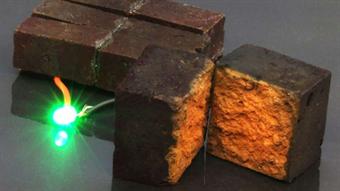 Red brick device developed by chemists at Washington University. Source: D'Arcy laboratory, Department of Chemistry, Washington University in St. Louis
The end result, according to the team of chemists, are energy-storing bricks capable of holding substantial stores of energy to charge devices like LED lights, for instance.
Enhancing bricks in a building with this capability, according to researchers, could mean that the bricks could serve as an emergency power source in the event of grid outages, for example.
The chemists detail their findings in the paper, "Energy storing bricks for stationary PEDOT supercapacitors," which is published in the journal Nature Communications.
For more on the bricks, watch the accompanying video that appears courtesy of Washington University.



"A symmetric brick-based supercapacitor shows an areal capacitance of 1.60 F cm−2 and energy density of 222 µWh cm−2 at a current density of 0.5 mA cm−2."
https://www.nature.c
1.6 farads per square centimeter?