Bricks Made with Cigarette Butts May Be Cheaper, Better Insulators
John Simpson | June 21, 2016Bricks manufactured with cigarette butts could potentially save energy while helping solve a litter problem.
A team led by Dr. Abbas Mohajerani, senior lecturer at RMIT University's School of Engineering, has demonstrated that bricks incorporated with 1% cigarette butts maintained properties very similar to those of normal bricks while cutting production costs.
Mohajerani’s team discovered that adding cigarette butts can cut the energy required to fire bricks by up to 58%—and the greater the percentage of butts incorporated, the lower the energy cost. Fired-clay bricks made with cigarette butts were also lighter with better insulation properties—meaning reduced household heating and cooling costs.
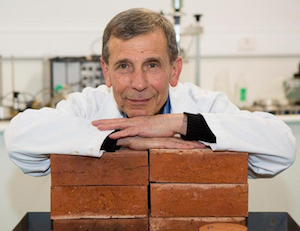 Dr. Abbas Mohajerani in his lab with the fired-clay bricks. Image credit: RMIT.Trillions of cigarettes are produced each year worldwide, resulting in the dumping of millions of tons of toxic waste into the environment in the form of cigarette butts, Mohajerani notes. As butts have poor biodegradability, it can take many years for them to break down, while heavy metals such as arsenic, chromium, nickel and cadmium trapped in the filters leach into soil and waterways.
But, when cigarette butts are used to manufacture bricks, the firing process traps and immobilizes those heavy metals and other pollutants, says Mohajerani. "Recycled cigarette butts can be placed in bricks without any fear of leaching or contamination," he says.
According to Mohajerani, in Australia alone, people smoke 25 to 30 billion filtered cigarettes a year and, of these, about 7 billion are littered. "This research shows that if just 2.5% of the world’s annual brick production incorporated 1% cigarette butts, we could completely offset annual worldwide cigarette production.”