Researchers turning old clothes into new
Marie Donlon | August 04, 2020Researchers from Fraunhofer Institute for Applied Polymer Research IAP in Germany and Swedish company Re:newcell have manufactured a viscose filament yarn using recycled cotton from discarded clothing.
Typically, cotton-based clothing items such a pants and jeans cannot be recycled into other items of clothing because the cotton is blended with other materials, making separation of the interwoven fabrics nearly impossible. As such, the researchers have devised a method for converting the pulp from recycled cotton into rayon viscose fibers composed of cellulose.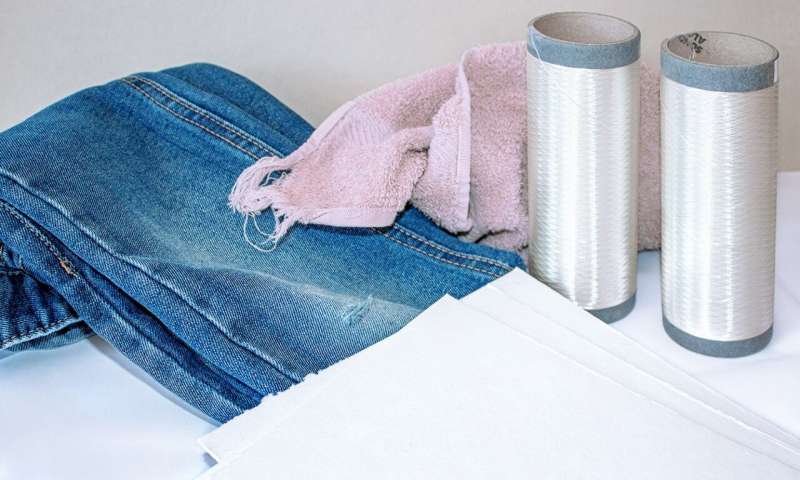 Wound onto a spool, the viscose filament yarn was spun from recycled cotton. Source: Fraunhofer IAP
Usually, pulp serves as the starter material for manufacturing regenerated cellulosic fibers, including viscose rayon, modal and lyocell, which do not melt. Consequently, it is dissolved in a solution and passed through a spinneret, which is a thimble-shaped nozzle with fine holes that form the cellulosic filaments. Often, the feedstock is wood. However, the team extracted foreign fibers from Re:newcell's cellulose sheets composed of recycled cotton with the goal of converting it into viscose rayon fibers.
The team reportedly extracted the foreign fibers from the pulp via dissolving and spinning processes and filtration stages, thereby yielding a filament yarn of 100% cellulose. According to researchers, the quality was equal to that of wood-based fiber. Additionally, researchers determined the new fibers derived from the cotton pulp can be used to mass manufacture textiles.
Forgoing the complicated process of manufacturing viscose rayon, the new fiber is an ecofriendly, pure cellulose that will not contribute to the mounting microplastics polluting the world’s oceans. Instead, the material decomposes, thereby improving upon commonly used petroleum-based polyester fibers.
"Cotton clothing is usually incinerated or it ends up in the landfill. Now it can be recycled several times to contribute to greater sustainability in fashion," said André Lehmann, a researcher at the Fraunhofer IAP. "The starter material for viscose rayon fibers has been wood-based cellulose. By optimizing the separating processes and intensifying the filtration of foreign fibers in the spinning process, we will eventually be able to establish recycled natural cotton fiber as a serious alternative source of cellulose and base raw material."