Clotting agent enables first responders to slow internal bleeding
Siobhan Treacy | August 03, 2020Researchers from Harvard John A. Paulson School of Engineering and Applied Sciences (SEAS), Massachusetts General Hospital, Beth Israel Deaconess Medical Center and Case Western Reserve University created an injectable clotting agent that reduced blood loss by 97% in mice, which will further their goal of giving first responders a tool to stop internal bleeding long enough to get a patient to the hospital.
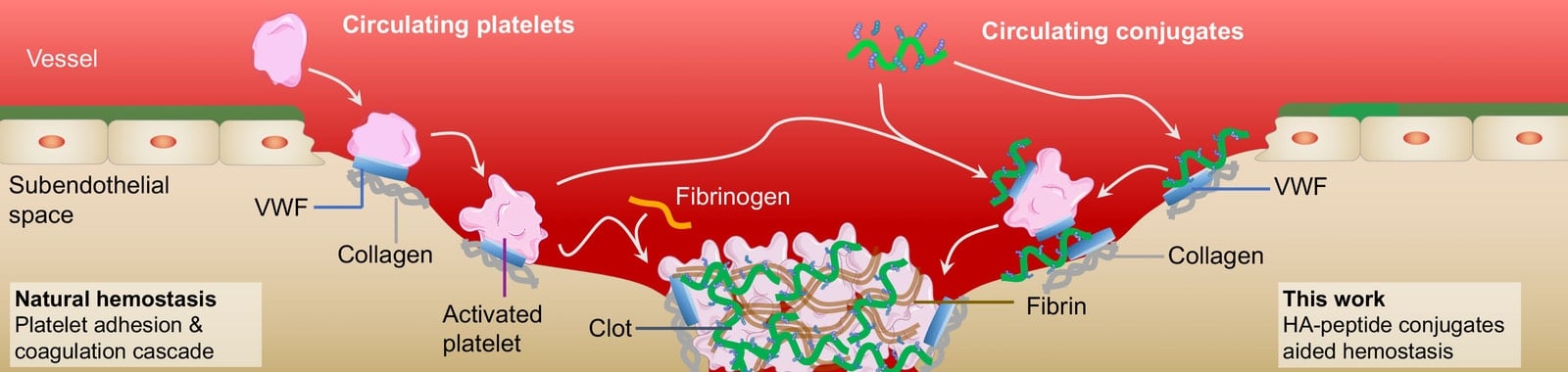 This graphic explains how HAPPI accelerates the blood clotting process at wounds. HAPPI binds to the molecules known as van Willebrand Factor (vWF) and collagen at the site of vascular injury and vWF attached to activated platelets. Source: Mitragotri lab/SEAS
The team’s new clotting agent, which is called hemostatic agents via polymer peptide interfusion (HAPPI), is freeze-dried and has the physical consistency of cotton candy. It can be stored at room temperature for months and reconstituted with saline. HAPPI selectively binds to damaged blood vessels and activates platelets at the bleeding site. When injured platelets are activated, they attach to the damaged blood vessel and cause blood to clot. HAPPI binds to activated platelets and enhances accumulation at the bleeding site.
The team tested HAPPI on mice and they found that the agent lowered bleeding time and the volume of injuries. They saw a 99% reduction in bleeding time and a 97% reduction in blood loss. In traumatic injuries, HAPPI increased the median survival rate beyond one hour.
Patients with major hemorrhaging often die within minutes from blood loss. As such, staunching the wound and quickly transporting a victim to the hospital is critically important to survival. Although external bleeding can be slowed with compressions, it does not work for internal bleeding. In a hospital, internal bleeding is controlled with clotting agents that require careful storage and refrigeration. This cannot be implemented by first responders when slowing bleeding is the most important.
The initial testing was done on mice, but the team said their next step is to test HAPPI on larger animals and scale up production.
A paper on the research was published in Science Advances.