Researchers unveil AI-based lifeguard
Marie Donlon | July 27, 2020Scientists at the Ben-Gurion University of the Negev in Israel have developed an artificial intelligence (AI) based lifeguard to help overtaxed lifeguards at overcrowded beaches to identify potential safety hazards.
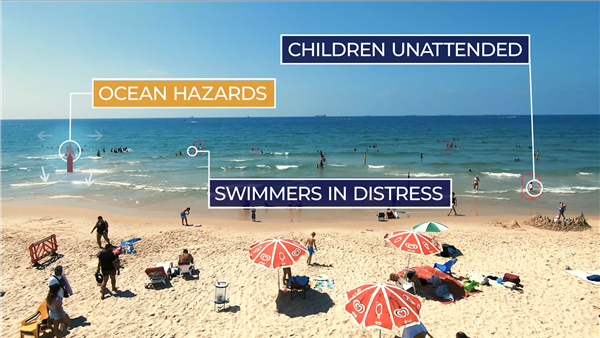
The AI lifeguard, called Sightbit, monitors sunbathers using a system of deep learning computer vision, convolutional neural networks and standard cameras to identify potentially hazardous situations that might go unnoticed by a human lifeguard.
A rating system is applied to each section of beach according to a risk assessment model based on factors such as weather and the number of people on the beach. This data then informs decisions about the number of lifequards necessary on the beach on any given day and where along the beach lifeguards should focus their efforts.
 Source: Ben-Gurion University of the Negev
Once the system detects a potentially hazardous scenario, Sightbit will issue a warning that will appear on a connected display located at the lifeguard towers, drawing the lifeguards’ attention to that region on the beach.
The system can also reportedly identify high-risk groups of beachgoers — swimming children, boaters and jet skiers for instance — who might need lifeguard assistance.
According to its developers, the technology could potentially prove life saving, particularly during the warmer months when beaches are crowded, and lifeguards must handle a host of competing distractions including swimmers in distress and ocean hazards, for instance.
The Israel Nature and Parks Authority intends to outfit Israel’s Palmachim National Park, and its five miles of coastline with the technology, making it what the team considers the world’s first "smart beach."
For more information on Sightbit, watch the accompanying video that appears courtesy of Ben-Gurion University of the Negev.