Team answers mystery surrounding high-performance data storage
Amy J. Born | July 14, 2020Today's magnetic hard drives are made of magnetic thin films that allow high data storage density and increased drive capacity by heating ultra-small nano-domains using a laser, a technology known as heat-assisted magnetic recording (HAMR). The volume of the invar materials barely expands when heated and until now, the reason for this has been unknown. Now, however, researchers from Helmholtz Zentrum Berlin (HBZ) and the University of Potsdam (Germany) report that they have observed how this phenomenon occurs.
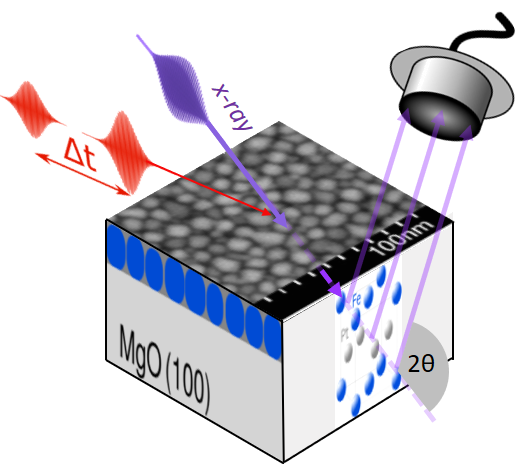 Two laser pulses hit the thin film of iron-platinum nanograins at short intervals: the first laser pulse destroys the spin order, while the second laser pulse excites the unmagnetized sample. An X-ray pulse then determines how the grid expands or contracts. Source: M. Bargheer/University of PotsdamAccording to the research, a spin-lattice interaction in the iron-platinum (FePt) thin films cancels out the thermal expansion of the crystal lattice. Normally, heat causes lattice vibrations that result in expansion to create more space for vibrating atoms. This is not the case when heating the spins in FePt, which is in a class of invar materials that expands very little when heated. The warmer the spins, the more the material contracts following the direction of magnetization.
"We were surprised to find that the continuous crystalline layers expand when heated briefly with laser light, while loosely arranged nano grains contract in the same crystal orientation," explained Bargheer. "HAMR data memories, on the other hand, whose nano-grains are embedded in a carbon matrix and grown on a substrate react much weaker to laser excitation: They first contract slightly and then expand slightly."
The researchers determined that in the perfect film there is no room for expansion in the plane. In addition to exceptionally robust magnetic properties, FEPT embedded in a carbon matrix has thermomechanical properties that prevent heat from creating the excessive tension that would destroy it. This is significant for HAMR.