
Video: A simple DIY ventilator for COVID-19 patients
S. Himmelstein | July 13, 2020A low-cost ventilator was developed at the University of Glasgow to help fill the COVID-19 pandemic equipment supply gap and aid patients until more complex care is indicated. Production of the GlasVent can be quickly scaled to provide basic ventilatory support during periods of peak infection and associated ventilator demand.
The do-it-yourself (DIY) emergency ventilator is based on the automation of the manually operated bag valve mask widely used to deliver air into a patient’s lungs. A 3D-printed slide-crank mechanism is used to compress 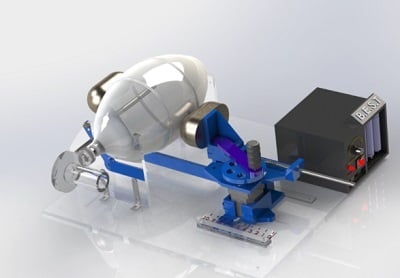 The design of the GlasVent emergency ventilator. Source: University of Glasgowthe bag in a design offering improved reliability, reduced heat generation, lower risk of electronics failure and a simplified interface with the motor. The GlasVent ventilator can be operated manually or with help of available battery powered tools such as electric drills, making the device feasible for off-grid operation.
The motor and pressure sensor are interfaced using an Arduino microcontroller. The sensor and motor circuitry monitor device operation, generate malfunction alerts and control breathing rate. The Arduino also enables connection with a laptop to provide visual indications of pressure and other status variables as well as more precise control and modes of operation. The batteries are estimated to operate from full to depleted for about 4 hours, affording sufficient time for a patient to move from residence to hospital.
The GlasVent system was tested with a medical dummy and demonstrated delivery of constant breathing to the artificial lungs. Plans are being finalized for the design of a fully manual version, a mains-powered version and a battery-powered unit.


I hope that it will really be useful for patients with coronovirus