New tool helps make predictions about hydraulic fracturing yields
Marie Donlon | June 24, 2020To better estimate oil and natural gas yields from hydraulic fracturing — the process of obtaining oil and natural gas from porous shale rock thousands of feet below the Earth’s surface via drilling — researchers from Texas A&M University have devised a procedure that can help shale operators make predictions before drilling commences on new wells.
Applied to spreadsheets, the new procedure makes predictions about natural gas and oil flow potential from new wells based on data about gas and oil flow amounts from old wells within the same drilling field.
To make current yield predictions, researchers generally examine factors such as rock permeability, underground geography and seismic data from the new drill site and this data is often used to develop 3D model simulations of new reservoirs before actual drilling. Such simulations, according to the team, can take anywhere from hours to weeks to complete, generally, depending on the number of blocks within the reservoir grid — in some cases, a reservoir model can contain billions of blocks.
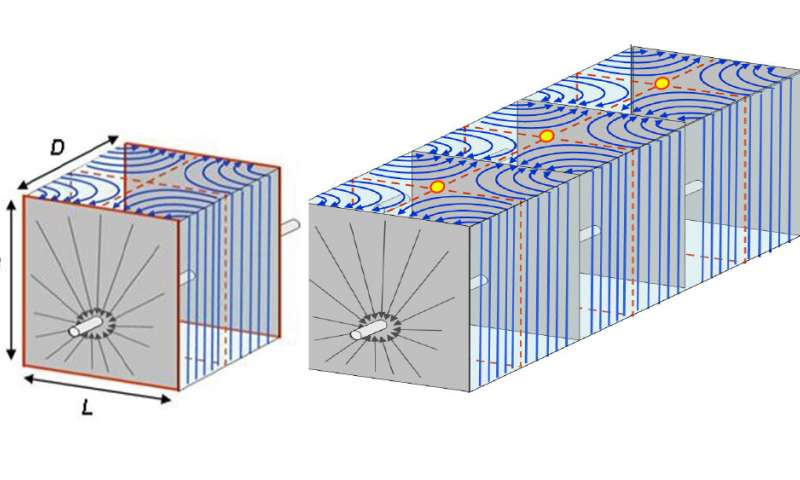 A schematic of a single flow block (left) and a series of flow blocks (right). Oil and gas flow from the porous rock into the cracks and then to the wellbore. Source: Dr. Weijermars
However, the Texas A&M team enabled the model to isolate small blocks of the reservoir model, simulating oil flow through each block according to pressure differences on the assorted block faces. By calculating the oil flow from the point of fracture to a single block within an existing well, assuming all flow blocks in the reservoir are identical, researchers were able to expedite predictions.
Those predictions were then measured against predictions from simulations and the researchers determined that while they both performed well, the spreadsheet tool made its predictions much faster.
According to the findings, once the team modeled the flow rate from an existing well, they could calculate and subsequently improve new well behavior by modifying certain characteristics of the flow blocks, for instance the block’s height, length or spacing of hydraulic fractures.
Because hydraulic fracturing is an often costly and time consuming process, sometimes failing to yield enough oil flow to make the process worthwhile, the new Texas A&M tool could potentially improve yield amount predictions, thereby eliminating wasted resources spent attempting to recover oil before drilling commences.
The new tool is detailed in the journal Energies.