Team builds precise polyrotaxanes with tiny pumps
Engineering360 News Desk | June 23, 2020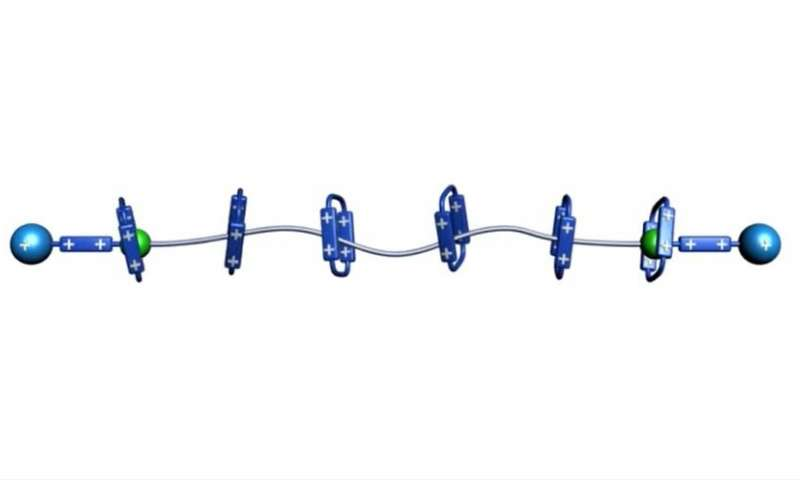 Source: Northwestern UniversityA team of researchers from Northwestern University has developed a precise method for constructing polyrotaxanes, which are mechanically locked polymers for slide-ring gels, battery electrode materials and drug-delivery platforms, among other applications.
To build the polyrotaxane molecules, which are composed of rings threaded onto a polymer string, the method relies on two artificial molecular pumps to install the rings onto the ends of the polymer string. These small pumps enable researchers to precisely direct the number of rings that pass onto the polymer — which was previously impossible to do with a specific number of rings, according to researchers.
"Traditionally, researchers mix the rings and polymers together, and they form inclusion complexes by noncovalent interactions," said Yunyan Qiu, a postdoctoral fellow at Northwestern. "But you couldn't know how many rings were threaded until you analyzed it later using nuclear magnetic resonance microscopy. People could roughly control the percentage of rings to some extent, but it was still an estimate."
To develop the new method, the researchers employed an artificial molecular pump powered by redox reactions that drives molecules from a low-energy state to a high-energy state.
To develop polyrotaxanes, the pump uses repeated redox reactions either chemically or electrochemically, wherein a molecule gains or loses electrons. At first, the pumps — which are situated at either end of the polymer string — and the rings are positively charged, thus repelling each other.
Once the electrons are injected, units in both the pumps and the rings transition from dicationic to radical cationic states and the rings are then drawn to the pump heads, threading onto both ends of the polymer string. Consequently, oxidation eliminates the electrons, thereby restoring the positive charges. Meanwhile, the rings, which attempt to escape are thwarted due to the positively charged units at either end of the polymer string. Mild heating enables the ring to surpass speed bumps and access the polymer chain — a process that is repeated by the pump to recruit ring pairs onto the polymer string.
"We can recruit up to 10 rings onto the thread," Qiu said. "But we believe we're only limited by the length of the chosen polymer chain. If we double the length of the polymer, we can double the number of rings."
The Northwestern team also envisions that the technique could use different types of polymers to construct non-traditional polyrotaxanes with unusual properties.
The research appears in the journal Science.