Electrodes promise faster, cheaper hydrogen production
S. Himmelstein | June 12, 2020The role of hydrogen as a storage medium for renewable energy is expected to benefit with materials that improve the efficiency and affordability of electrolysis. Three materials for flow-through electrode fabrication were demonstrated by Duke University researchers to boost the productivity of electrolyzers.
Nickel electrodes composed of foam, microfiber felt or nanowire felt were tested to examine the tradeoff between surface area and pore structure on the performance of alkaline electrolyzers. The nanowire felt had the highest surface area and initially provided the highest hydrogen generation efficiency but its performance 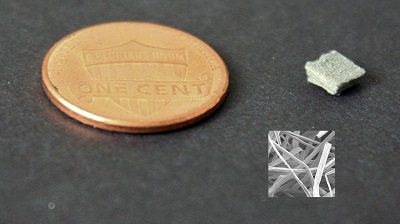 One of the small, flow-through electrodes demonstrated to produce more hydrogen from electrolysis. Inset: Electron microscope view of the felt. Source: Wiley Lab, Duke Universityquickly declined as gas bubbles were trapped within the electrode. The open structure of the foam facilitated bubble removal but the small surface area limited its maximum performance. The microfiber felt exhibited the best performance because it balanced high surface area with the ability to remove bubbles.
The microfiber felt maintained a maximum current density of 25,000 mA/cm2 over 100 hours of testing without degradation, which corresponds to a hydrogen production rate 12.5- and 50-times greater than conventional proton‐exchange membrane and alkaline electrolyzers, respectively.
The materials could be used to enhance the structure of electrodes, which could lead to increases in hydrogen production rates and declines in commercial electrolysis costs.