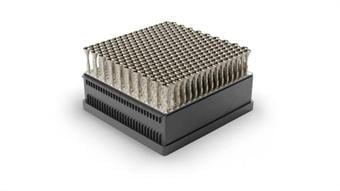
Watch: Bioreactor designed to produce pharmaceuticals in space
S. Himmelstein | April 13, 2020The Gram-negative bacterium Escherichia coli is commonly cultivated for the manufacture of pharmaceuticals, a process which Rensselaer Polytechnic Institute researchers are extending to extraterrestrial applications. A space-based bioreactor system is under development to support E. coli growth and enable production of drugs on demand during space missions.
Nurturing anaerobic bacteria in a liquid growth medium typically relies on an orbital shaker which horizontally 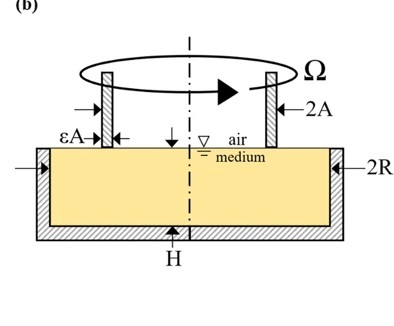 Schematic of the viscometer denoting the knife edge radius A, cylinder radius R, knife edge angular velocity Ω, cylinder height H, and knife edge thickness εA. Source: Joe A. Adam et al.shakes a platform hosting liquid-filled containers. Instead of adapting this method, which relies on the force of gravity to swirl the liquid contents, for space use the researchers opted to test a NASA-built instrument that harnesses shearing force. The knife-edge surface viscometer uses a syringe to dispense a drop of liquid which forms a bubble. One side of the bubble adheres to a stationary ring and the other adheres to a thin rotating ring designed to generate shear force on the surface of the bubble, swirling its contents.
Bacterial growth was monitored and compared in both the knife-edge viscometer and an orbital shaker operated at various speeds. Growth rates in the viscometer were comparable to those in the shaker at higher speeds. At lower speeds, the shear force induced in the viscometer supported faster E. coli growth.
At higher speeds, bacteria aerated by the knife-edge viscometer showed growth rates approaching that of the orbital shaker. Even at lower speeds shear force produced significantly more growth than samples of bacteria that were not mechanically aerated, indicating that the viscometer system is as effective as the shaker for protein expression and bacterial viability.
The researchers hope to conduct similar tests aboard the International Space Station and to use the viscometer to culture radiation-resistant microorganisms which could protect pharmaceuticals from the constant barrage of extraterrestrial radiation.
The research is published in Nature Microgravity.