6 questions on lidar for AVs, with Insight Lidar
Amy J. Born | March 17, 2020The term lidar is shorthand for light detection and ranging, or light imaging detection and ranging. The technology uses lasers to shoot beams of light (at rates as high as 150,000 pulses per second) at an object and measures how long it takes the light to bounce back. A sensor collects the data from each returned beam of light and creates a digital 3D representation of the object.
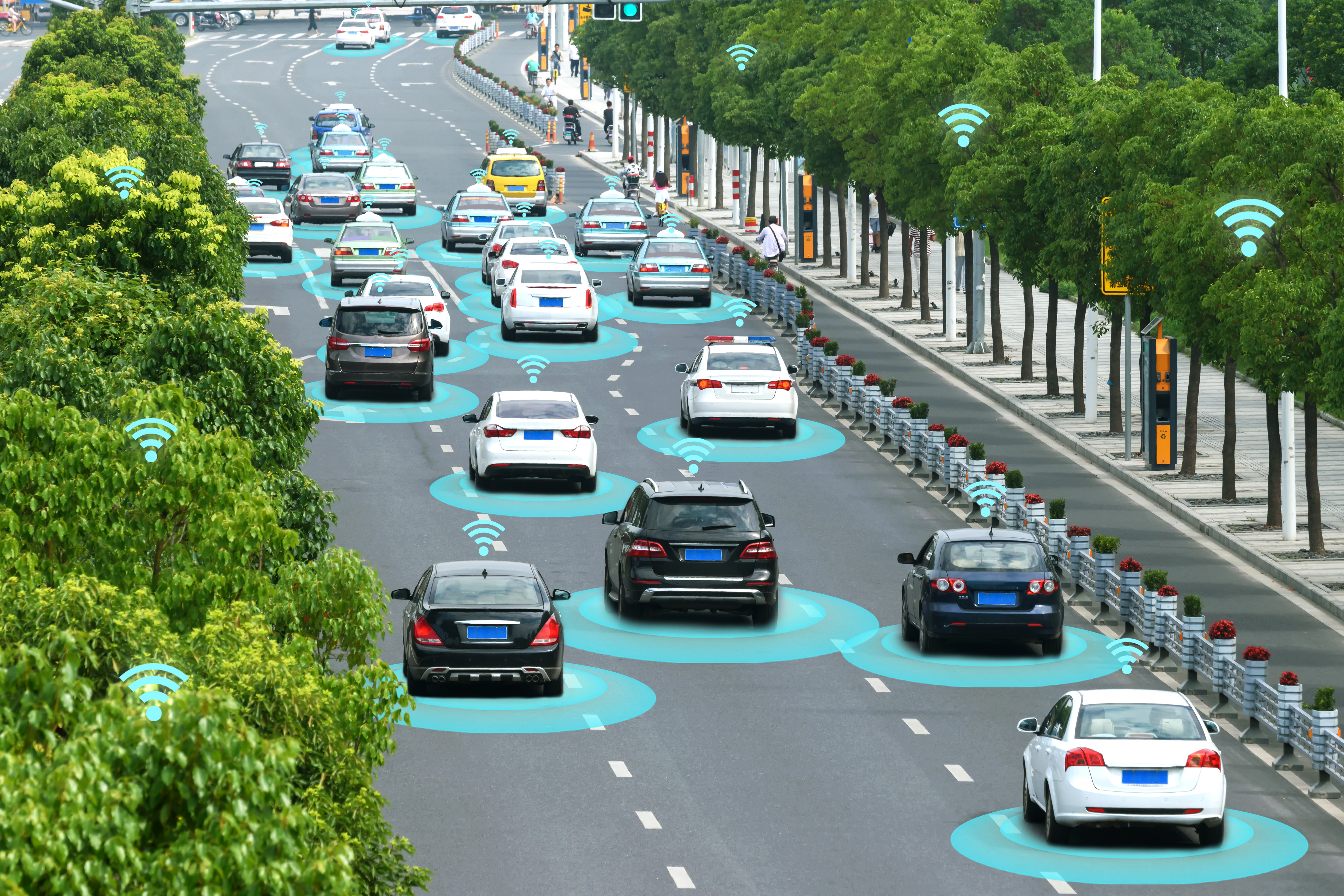
Lidar has applications in many fields but one of the fastest-growing is in the autonomous vehicles (AV) sector. Most autonomous vehicles use a combination of sensors — cameras, GPS and lidar — to see and evaluate what is around them. Today, most car manufacturers, with the notable exception of Tesla, believe all three types of sensors are necessary for the safe operation of AVs because they have complementary strengths and provide redundancy when used together. Conventional cameras capture color with fairly good resolution but are not effective in the dark or in certain weather conditions. Radar, used for adaptive cruise control, can detect objects at a distance but cannot tell what the objects are. Lidar provides a 3D range of information about the surroundings but cannot see color (i.e., it knows there is a stoplight, but not whether it is red, yellow or green).
To learn more about how lidar is being developed for the AV market, Engineering360 spoke with Greg Smolka, vice president of business development at Insight Lidar, a unit of Insight Photonic Solutions, based in Boulder, Colorado. 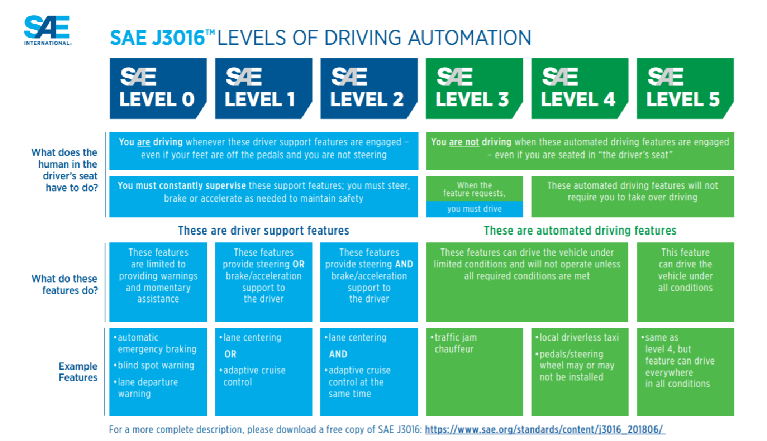 SAE J3016 Standard: Levels of Driving Automation. Source: SAE International
Eng360: What are the key engineering breakthroughs that are necessary for advancing lidar technology?
Smolka: Lidar is a key sensor to help us see the world. The big question is how well do we need to see it? To get to fully autonomous, which is level 4 of autonomous driving defined by the Society for Automotive Engineers (SAE International) requires multiple engineering breakthroughs in lidar, specifically in the areas of range, resolution, detection, cost and size.
Range refers to how far it can see. The goal is 200 m away (just over two football fields). A car traveling at highway speeds covers that distance in seven seconds and needs to be able to detect, see and react in a fraction of a second. Reflectivity factors into that. A tire is a 10% reflective item. A white car is 40% reflective but a black car may only be 2% to 3% reflective.
Resolution determines how sharp the image of something is at a distance. Lidar companies have dealt differently with this. AV people tell us that to detect and understand an object (say, a child) requires 40 pixels on the object. Most lidar systems now are low resolution and will only get a couple of pixels at 200 m. Insight’s key advantage is having ultra-high res in development that can put 40 pixels on a child at 200 m.
 Detection is either time of flight (ToF), which is most common, or frequency modulated continuous wave (FMCW). ToF lidar shoots a very short pulse width laser beam, a few nanoseconds wide, and times how long it takes to reach an object and bounce back to the sensor. Range is computed by comparing the laser beam round trip time to the speed of light. Velocity of an object can also be determined by calculating the range of an object at several different times and deriving the velocity arithmetically. For AV’s, however, the time required to take multiple range readings and perform the calculations can be problematic. For example, an AV executing an unprotected left turn must calculate the velocity of an oncoming vehicle and determine if it is safe to turn in front of the approaching car. Additionally, ToF results vary if the sensor is pointed directly at or away from the sun and can be affected by other lidar, which will become a problem when there are more systems out there.
FMCW sends out a frequency (a burst of light). The sensor looks for the exact emitted frequency burst to come back and rejects all other light. For this reason, FMCW detection is unaffected by sunlight or other lidar so its performance does not degrade in these conditions. It is also much more sensitive than ToF, meaning that it can range to low reflectivity objects over 200 m away. Perhaps the main advantage of FMCW detection is the ability to get both range and velocity information, instantly, for every pixel. For example, it can tell me that the object is 150 m away and is traveling towards me at 50 mph.
Cost needs to drop substantially. Today each sensor is $10,000 to $30,000. An AV typically needs four to six lidar sensors. Manufacturers want the cost ideally under $300 when volume gets into the millions of units. Success depends on our ability to design a system that hits those price targets at that volume, and that will be determined by the architecture of the system. Insight has everything required to make the light source and all the processing on PICs (photonic integrated circuits) on a wafer at high volume. Many others don’t have the architecture to get the costs down and instead are finding new uses for lidar in other areas, such as security, industry and mapping.
Size needs to be at chip-scale. A lidar system that gets to level 4 or 5 doesn’t currently exist but Insight is in the process of miniaturizing our technology. We’ve proven all the performance specs today, and are now miniaturizing to build in high volume. Insight is working with the largest AV companies to learn from them what the sensors have to do.
Eng360: What is the status of industry standards and standardization for lidar?
Smolka: It doesn’t exist right now. That is frustrating for users because they can’t compare systems easily. Lidar companies use different metrics, different testing conditions. Standardization will happen over the next few years. There needs to be consistency in the way data is pulled together. Not all lidar is the same. Mid- to long-range (what Insight is developing now) detects objects at that 200 m distance. There is also a need for short-range to detect someone right in front of the vehicle.
Eng360: Where is the development of lidar technology happening primarily?
Smolka: The U.S. is very strong, with pockets in Silicon Valley. We’re in Boulder, Colorado. There is a lot of experience and expertise in FCMW here because of past military work. Globally, China is mainly developing ToF lidar because it is simple from a hardware perspective; there is less development on FCMW, because it has better patent protection. Israel is another area developing lidar.
Eng360: How do approaches to the technology’s development vary by market and by manufacturer?
Smolka: The main difference is short-range versus long-range. Techniques vary between the two. Insight focuses on long-range because it is a good fit for our technology.
Some companies in the space now will exit AV for other markets. What will drive that is whether they can develop a low-cost sensor for the automotive market.
Eng360: What key technology breakthroughs are on your wish list?
 Greg Smolka, Insight LidarSmolka: Long-range, very high resolution on a chip scale is the game-changer. And getting to that under-$300-per-sensor cost. We believe that will happen. It takes a lot of effort but the biggest AV manufacturers believe we are on the path to get there.
Eng360: What will the rollout of autonomous vehicles look like and why do we need them?
Smolka: Rollout will happen over time, starting first in the shuttle market -- autonomous, non-personal-vehicle ownership. Shuttles will operate within the city, to airports, at assisted living facilities. We’ll see more and more over the next three to five years. Personal vehicles will take longer, at least 10 years. The technology has to get cheaper and better. So many weird situations come up. We can’t simulate them, we have to experience them and put the sensors through their paces. AV and personal human-driven vehicles will be operating together for a time.
A hundred people a day die in car accidents in the U.S. This is an impact we can have on people’s lives that is bigger than anything else in the automotive industry, including seatbelts and airbags.