Satellite data detail per capita CO2 emissions in cities
S. Himmelstein | March 10, 2020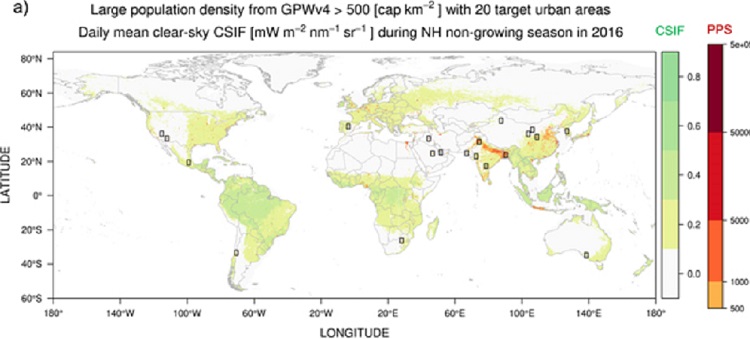 The distribution of target cities and 1 km × 1 km population density trends. Source: Dien Wu et al.
Urban areas are responsible for more than 70% of global energy-related carbon dioxide (CO2) emissions associated with energy production. The contribution of per capita emissions to the CO2 load of cities has been analyzed by researchers from NASA, the University of Utah and the University of Michigan based on CO2 estimates from NASA's Orbiting Carbon Observatory-2 (OCO-2) satellite.
Evaluation of data for 20 cities indicates that most urban regions with higher population densities generally have lower per capita CO2 emissions. However, cities with major power generation facilities, such as Yinchuan, China, and Johannesburg, had higher emissions than what their population density would otherwise suggest. More affluent cities, including Phoenix, produce more emissions per capita than a developing city like Hyderabad, India, which has a similar population density.
Higher per capita emissions in Phoenix might be ascribed to higher rates of driving and other factors, while the lower emission rates determined for most other cities might be explained by the use of shared mass transit infrastructure or greater penetration of renewable-based power systems.
More detailed data are now being collected by OCO-3, the recently launched successor to OCO-2. The new satellite will take more frequent observations with a wider spatial coverage around hundreds of cities, providing additional information for emissions quantification and mitigation.
The study is published in Environmental Research Letters.