US crude oil production notched records in 2019, EIA says
David Wagman | March 02, 2020Annual U.S. crude oil production reached 12.23 million barrels per day (b/d) in 2019. That was 1.24 million b/d, or 11%, more than 2018 levels, according to the Energy Department's Energy Information Administration (EIA).
The 2019 growth rate was slower than the 17% growth rate reported in 2018.
 Source: EIAMonthly production in November averaged 12.86 million b/d, the most in U.S. history, EIA said.
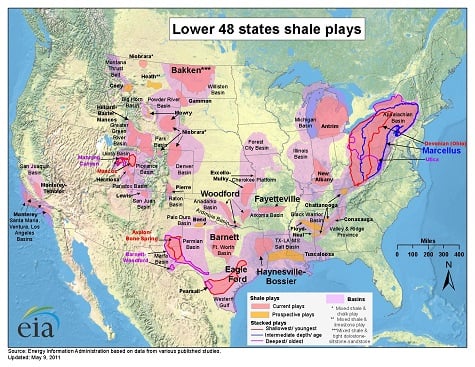
U.S. crude oil production has grown during the past 10 years, driven mainly by production from tight rock formations developed using horizontal drilling and hydraulic fracturing to extract hydrocarbons.
Texas growth
EIA said that Texas continued to produce more crude oil than any other U.S. state or region, accounting for 41% of the 2019 national total. Texas crude oil production averaged 5.07 million b/d and reached a monthly record of 5.35 million b/d in December.
 Source: EIA
Texas' production increase of almost 660,000 b/d in 2019 — driven by significant growth within the Permian region in western Texas — was 53% of the total U.S. increase for the year. Texas crude oil production has grown by 3.9 million b/d, or 333%, since 2010.
Several other U.S. states or regions set production records in 2019, EIA said. The Permian region drove a 248,000 b/d, or 36%, crude oil production increase in New Mexico. This was the second-largest state-level growth in 2019 and accounted for 20% of the total U.S. increase. In 2019, New Mexico set a new oil production record for the third consecutive year, growing by 749,000 b/d since 2010.
Offshore GOM
In the Offshore Federal Gulf of Mexico, new projects contributed to the region’s growth in production in 2019. Oil and natural gas producers brought seven new projects online in 2019, and EIA said it expects nine more in 2020.
The Offshore Federal Gulf of Mexico’s crude oil production grew by 126,000 b/d in 2019, leading to the area’s highest annual average production of 1.88 million b/d. The Offshore Federal Gulf of Mexico was the second-largest crude oil producing region in the United States in 2019.
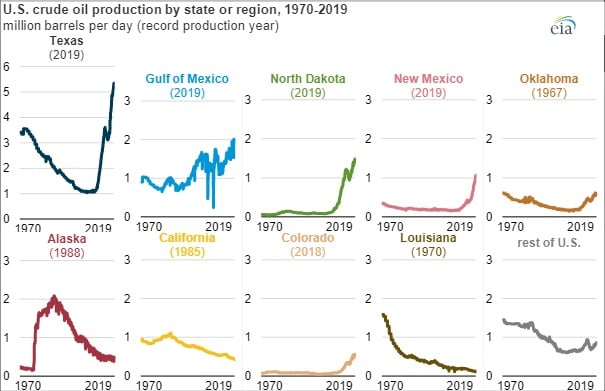 Source: EIAColorado and North Dakota also set record production levels in 2019 of about 514,000 b/d and 1.4 million b/d, respectively. The Niobrara shale formation drove production increases in Colorado, EIA said.
Continued production in the Bakken region drove increases in North Dakota. Production in Oklahoma rose by 32,000 b/d in 2019 but did not surpass the state's record production of 613,000 b/d set in 1967.
Production declines
EIA said that increases in these states and regions more than offset production declines elsewhere. Alaska’s crude oil production fell for the second year in a row. California’s declined for the fifth year in a row.
EIA said it forecasts U.S. crude oil production will continue to increase in 2020 to an average of 13.2 million b/d and to 13.6 million b/d in 2021. Most of the expected production growth will occur in the Permian region of Texas and New Mexico.