
Sandia shares cooling unit operational details
David Wagman | February 19, 2020A thermosyphon cooler on the roof of a supercomputer center at Sandia National Laboratories is being credited with saving more than half a million gallons of water during its first six months of operation in 2019.
The unit reportedly also saved more than 195,000 kilowatt hours of electricity during the same time period by making it unnecessary to pump water through mechanical chillers.
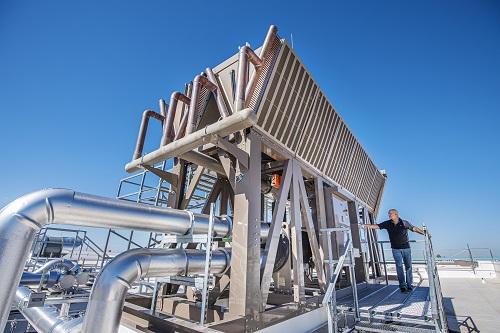 A thermosyphon cooler on the roof of Sandia’s supercomputer center is inspected by engineering project lead David J. Martinez. Thermosyphons cost $200,000 each from their manufacturer, Johnson Controls. Sandia has installed one, bought two more, and may buy a fourth. Source: Randy Montoys/SandiaElectricity that is used to run the servers of increasingly large supercomputers generates heat. Removing that thermal energy is expensive, Sandia said, either in the financial cost of powering mechanical cooling units or in the amount of water needed to replace water that is evaporated.
The thermosyphon cooling unit's refrigerant rests in a shell that surrounds an outgoing pipe. The refrigerant absorbs heat until the liquid evaporates into a gas. The gas rises in vertical pipes until it reaches the upper limits of the device. There, it gives up its acquired heat to the atmosphere, coalesces back into liquid and sinks down to cool again.
The cycle needs minimal maintenance, Sandia said. It works as long as the atmospheric temperature is less than that of the refrigerant; otherwise, the heat transfer reverses, from the atmosphere into the coolant.
 Martinez stands within the cooling unit's framing. In New Mexico, the system works for three seasons, but in summer, only at night. Source: Randy Montoya/SandiaHot summer days
In New Mexico, where Sandia is located, the system works for three seasons, but in summer, only at night. On hot summer days, the thermosyphon shuts down and water must be pumped to a mechanical chiller and then to a cooling tower, which evaporates water into the atmosphere.
Because minerals do not evaporate, the remaining water has a higher concentration of contaminants, which means it must be frequently changed before it fouls the cooling pipes. The evaporated and discarded water must be replaced. Those problems are almost eliminated with the new system, Sandia said.
Investment payback
Thermosyphons cost $200,000 each from their manufacturer, Johnson Controls. The company spec sheet for the cooler said that each single unit (with standard copper evaporator tubes) provides up to 386 refrigeration tons (TR) of cooling capacity with 95° F entering water/85° F leaving water at a 40° F ambient dry bulb temperature.
Water circuit pressure drop through the unit is 4 PSID at 600 GPM in a two-pass configuration. The company said that the unit's modular design means that any number of cooling units can be bundled together to meet desired water savings targets.
Sandia said it has installed one, bought two more, and may buy a fourth unit. For four units, annual cooling costs would drop from $181,000 to $116,000, which means a roughly 10-year payback in current dollars.
The real savings would come in water. When the data center reaches full design load, each thermosyphon unit is expected to be capable of saving more than 4.2 million gallons of water per year.


When students seek our Online Psychology Assignment Help Writing Services from us, they are assured to receive the best Psychology Paper Writing Services that meets all their writing needs and Psychology Essay Writing Service one that has been written following all the instructions.