Ice-source heat pumps turn up the heat
S. Himmelstein | June 24, 2025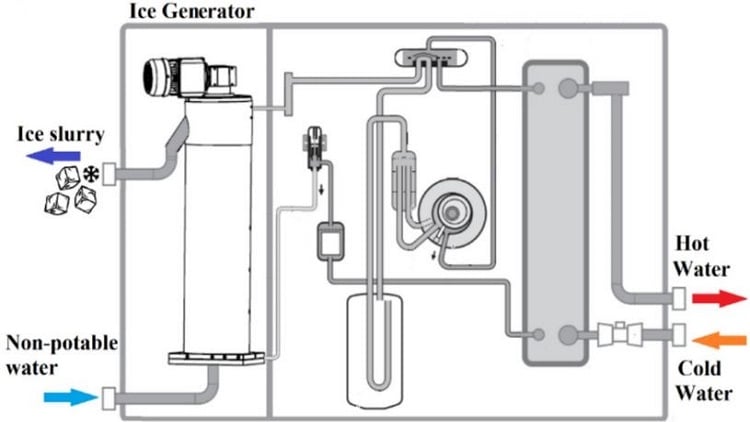 Schematic of the ISHP. Source: Energy and Buildings, CC BY 4.0
The feasibility of deploying ice-source heat pump systems (ISHPs) to replace conventional natural gas boilers for residential heating was explored by University of Nottingham, U.K., researchers. These systems can exploit existing, repurposed underground natural gas pipelines to supply the required water for heating and cooling. By harnessing the latent heat released during water freezing, this approach offers an efficient, sustainable solution with optimized water consumption.
The analysis published in Energy and Buildings evaluates the performance of a 7 kW system using propane as a refrigerant. Heat is extracted from the delivered water and transferred via the heat pump cycle to the circulating water within the building, which then heats the radiators. As a result, the incoming water is transformed into ice.
A compression refrigeration cycle moves hot compressed gas from the compressor to the condenser, which then releases heat to the heat sink, where it undergoes a phase change and transforms into a liquid, resulting in a temperature decrease. The liquid refrigerant then enters the evaporator, where it absorbs heat from the cold source and evaporates. The evaporated refrigerant returns to the compressor, where it is compressed again to restart the cycle.
While slightly less efficient than water-source systems, ISHPs reduce water consumption by 37.56 times, with minimal thermal losses, making them highly effective during peak cold periods. For an average residential unit in the U.K., the water distribution network capacity required is 2.3 times greater than the potable water network for average monthly use and 4.88 times greater under peak conditions without auxiliary systems. However, repurposed pipelines can provide water transfer capacities equal to 39.66 % of the energy previously supplied by natural gas during peak demand, making this technology viable for non-fuel heating systems.
Using existing infrastructure, such as extensive urban gas pipeline networks, for water transport is deemed cost-effective in this application.