
Robot trash talk has a negative effect on human performance
Siobhan Treacy | November 20, 2019Researchers from Carnegie Mellon University have found that humans are negatively affected by trash talk, even when it comes from a robot. During the study, participants played a game against a humanoid robot named Pepper. Pepper was either encouraging or discouraging to the players as the game went on. Players performed worse when they were on the receiving end of the trash talk.
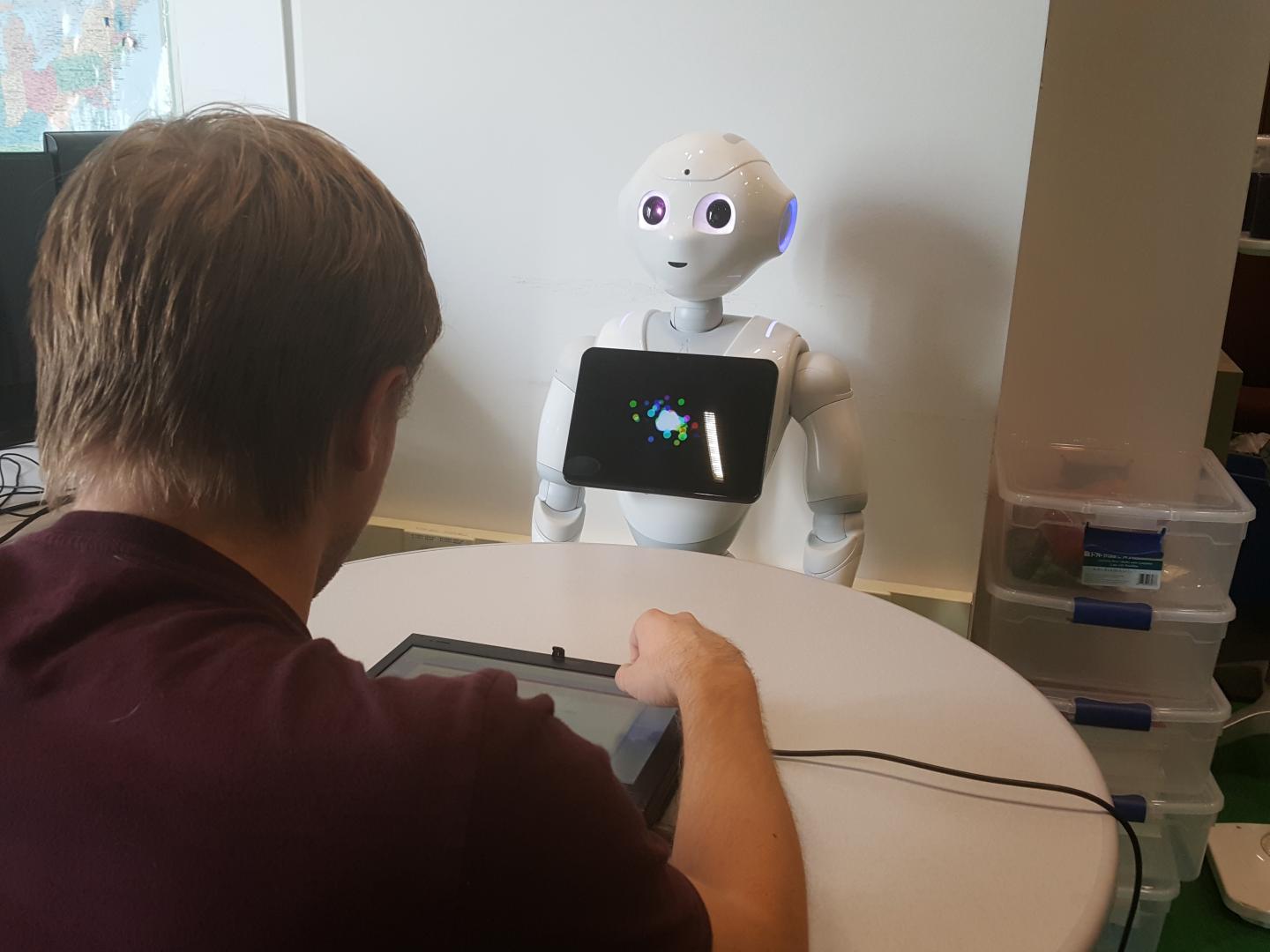 Researchers at Carnegie Mellon University have demonstrated that people who play a game with a robot suffer in performance when the robot criticizes them. (Source: Carnegie Mellon University)
This study was one of the first to examine human-robot interaction when humans and robots are not working together. It is important to examine these relationships as robots become more common in everyday life. In order for these robots and humans to work together successfully, all aspects of human-robot relationships must be examined.
A student project in assistant professor Fei Fang's class gave birth to the study idea. Fang, who is also a study co-author, has an appointment in the Institute for Software Research. His students wanted to explore game theory and bounded rationality with robots, so they studied how humans and robots played against each other during a game of “Guards and Treasures,” a Stackelberg game used by researchers to study rationality.
Forty study participants played a game with Pepper 35 times each. Selected participants played an additional 35 games. Pepper either offered words of encouragement or trash talk over the course of a game. The results showed that the rationality of human players improved with the number of games played, but players who were criticized didn’t score as well as players who were praised. Participants knew that the robot was the source of their poor performance, but they weren’t sure why a robot was affecting them so much. While it is known that performance is affected by what humans say to each other, this study proves a robot's words have the same amount of weight.
Pepper’s trash talk wasn’t especially cutting. Pepper would say things like: “I have to say, you are a terrible player” or “Over the course of this game your playing has become confused.” Despite the tame trash talk, players’ game performance was negatively affected by the negative words.
The researchers say that future work could focus on how nonverbal communication between robots and humans affects the human reaction. More work needs to be done to find how the type of robot, humanoid vs. computer box, may spark different responses in humans.
This research was presented at the IEEE International Conference on Robot and Human Interactive Communication.

"Your mother was a hamster and your father smelled of elderberries."