
This utility plans a big push in solar & battery energy storage
David Wagman | November 19, 2019Arizona-based Salt River Project (SRP) said it plans to invest in two solar energy & battery storage plants to help it replace power generated by the coal-fired Navajo Generating Station (NGS), which closed in mid-November.
The Sonoran Energy Center would be one of the largest solar-charged battery projects in Arizona, the public power agency said.
 The solar plants are expected to help SRP reach its goal of adding 1,000 megawatts (MW) of new utility-scale solar energy to its system by the end of fiscal year 2025. SRP also aims to cut the amount of carbon emissions per megawatt-hour by more than 60% by 2035 and by 90% in 2050.
The Sonoran Energy Center will be a roughly 250 MW system with the solar array charging a 1 gigawatt-hour energy storage system and will be built in Little Rainbow Valley, south of Buckeye, Arizona.
The Storey Energy Center will be a roughly 88 MW solar and energy storage system and is scheduled to be built south of Coolidge, Arizona.
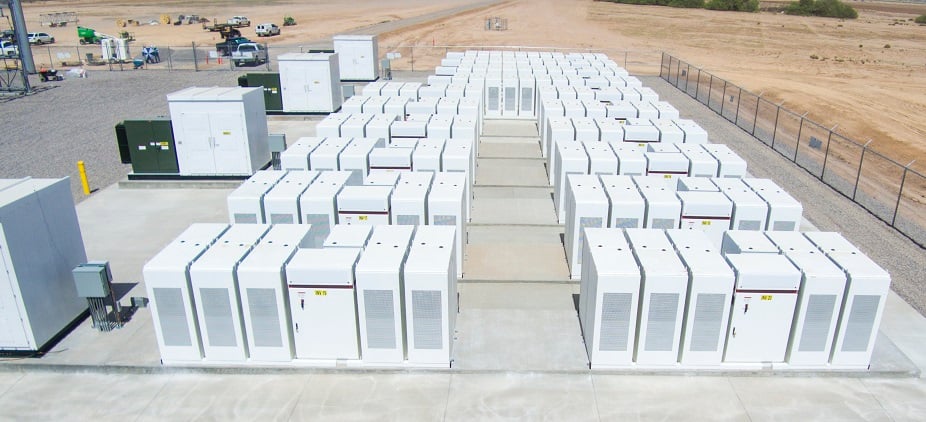 The 20 MW Pinal solar photovoltaic generation facility will store energy in a 10 MW lithium-ion battery storage system. Source: SRPThe projects were chosen through an open “All-Source” solicitation for resources and will help serve SRP’s summer peak load. Both plants are scheduled to be online by June 2023 and will be owned and operated by units of NextEra Energy Resources.
Energy storage growth
In July, the Energy Department said that operating utility-scale battery storage power capacity had more than quadrupled in the U.S. from the end of 2014 (214 MW) through March 2019 (899 MW). It said that if currently planned additions are completed and no current operating capacity is retired, utility-scale battery storage power capacity could exceed 2,500 MW by 2023.
The Energy Department defines utility-scale battery storage units as having 1 MW or greater power capacity. It credits growth in utility-scale battery installations to supportive state-level energy storage policies and the Federal Energy Regulatory Commission’s Order 841. That order directed power system operators to allow utility-scale battery systems to take part in their wholesale energy, capacity and ancillary services markets.
Shuttered coal
On November 18, SRP permanently shut down all three coal-fired units of the NGS located on the Navajo Nation east of Page, Arizona. The plant went permanently offline at 12:09 p.m. after Shift Supervisor Fred Larson, a 41-year NGS employee, opened the Unit 2 breakers.
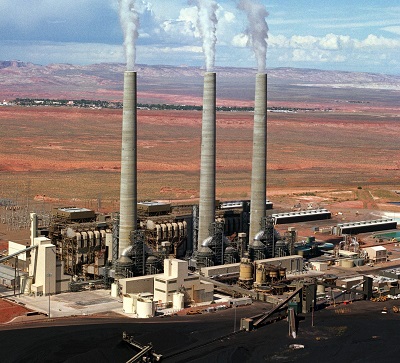 SRP permanently closed the three-unit Navajo Generating Station in November 2019. Source: SRPIn 2017, the owners of NGS determined it would be uneconomical to continue operating the 2,250 MW plant after its lease with the Navajo Nation expires in December 2019. Station owners include SRP, Arizona Public Service Co., NV Energy and Tucson Electric Power.
Under a 35-year agreement, the NGS owners will make lease payments totaling about $110 million to the Navajo Nation that will allow continued access to the site for decommissioning, long-term monitoring and ongoing operation of the electric transmission system.
Working with SRP, contractors will conduct demolition and reclamation work at the plant site. Work will include disassembling the power block, removing the catenary electrical system that powered the coal-carrying rail cars and addressing cleanup and restoration.
SRP said it expects that decommissioning will take around three years to complete at a cost of roughly $150 million. SRP estimated that more than 90% of the decommissioned plant will be salvageable.
The Navajo Nation will retain a number of facilities at the plant, including the warehouse and maintenance buildings, lake pump system and railroad, which are valued at around $18 million. The federal government will provide 500 MW of transmission capacity from the NGS transmission station that is valued at more than $80 million.
In addition, SRP is working with the Navajo Tribal Utility Authority to develop renewable energy projects within the Navajo Nation and has partnered with the Authority on the Kayenta I and II 28 ME solar power plants.
SRP said it offered new positions within the company to all 433 regular NGS employees and nearly 300 accepted offers. SRP said it also has told contractors handling decommissioning work to extend hiring preference for contract work to qualified members of the Navajo Nation.




As usual, I would like you to replace "renewable energy" with "zero-carbon energy."