
Rice University team develops 'bullet proof' polymer cubes
Marie Donlon | November 15, 2019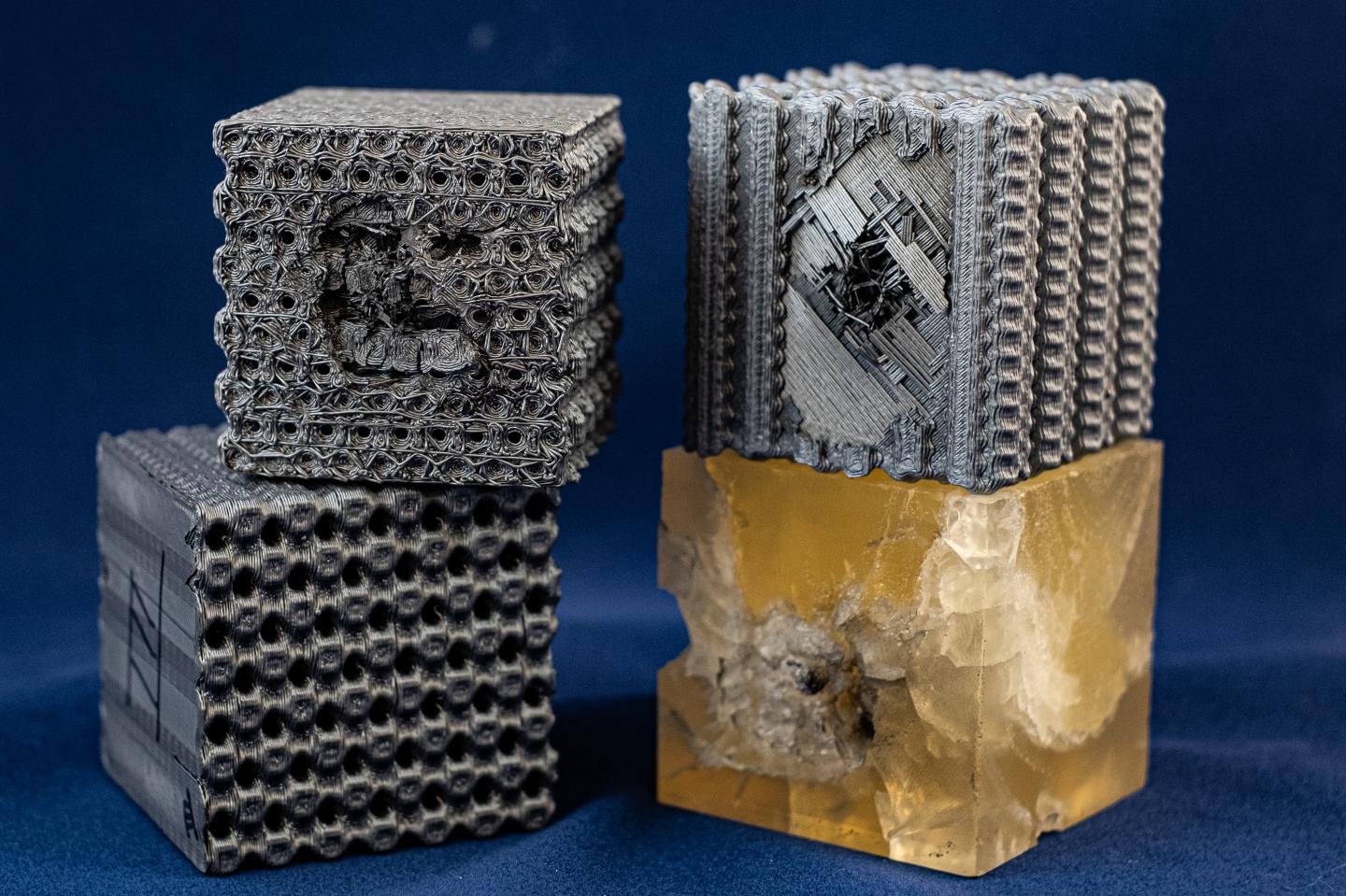 Tubulane-like polymer cubes were better able to withstand the impact of a bullet than solid polymer cubes. Source: Jeff Fitlow/Rice UniversityResearchers at Houston’s Rice University Brown School of Engineering have developed cubes of latticed polymer that can withstand the force of a bullet and other projectiles.
The 3D-printed polymer cubes are composed of a network of lattice layers and demonstrated the ability to withstand the force of impact from a bullet traveling at 5.8 km per second versus their solid polymer cube counterpart during lab tests.
The latticed polymer cubes were inspired by research conducted in the 1990s on theoretical microstructures called “tubulanes,” wherein researchers predicted that microscopic structures composed of crosslinked carbon nanotubes would eventually result in a material with excellent load bearing and impact resistant properties. The Rice University team set out to determine if such properties were achievable with 3D printing.
The team devised several different latticed and solid polymer cube computer-simulated designs to demonstrate whether or not the tubulane-inspired designs could better withstand the force of a bullet than a solid block of polymer might.
Once 3D printed, the cubes, both solid and latticed, were subjected to bullets and other forces. The impact of the bullet proved to create more damage in the solid polymer cube, causing it to crack throughout. Meanwhile, the lattice layered polymer cube managed to halt the bullet, limiting its damage to the second layer of the cube and keeping the rest of the block intact.
The tubulane inspired structure, according to its developers, could result in future materials for oil and gas, civil, biomedical, automotive, recreational, packaging and aerospace applications. Specifically, for the oil and gas industry, developers envision material appropriate for well construction, creating structures that are potentially impervious to forces encountered in hydraulic fracturing, for instance.
The research is published in the nanotechnology journal Small.



I wonder if filling the internal spaces with a non-Newtonian fluid would improve the resistance to high speed impacts?
Dear Sirs,
In addition to the impact resistance to the fast flying-in object, can it still retain adequate mechanical properties as flectural strength, tensile strength and compressive strength etc. to act as a suitable structure parts or component in comparison to its counterpart of solid polymer?
Regards
Johnhan
Nov. 25, 2019
These studies and innovative inventions show that students are very smart people at the university. Students need to improve their knowledge and read a lot of information, including www.mkfm.com/news/ne