Researchers develop magnetized artificial skin
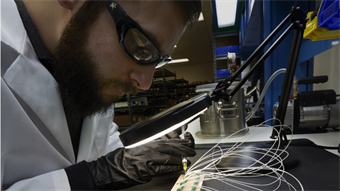
Marie Donlon | November 12, 2019 The artificial magnetic skin. Source: KAUSTResearchers from the King Abdullah University of Science and Technology (KAUST) in Saudi Arabia have developed artificial magnetized skin with the potential for use as wearables and as a human computer interface.
To create the magnetized skin, the KAUST team used a flexible biocompatible polymer matrix loaded with magnetized microparticles.
The artificial skin is lightweight as well as flexible and can be fashioned into virtually any shape or color. Its developers report that it is easily and inexpensively fabricated with the appropriate materials, training and tools.
The team attached the magnetic skin to a volunteer’s eyelids to track the subject’s eye movements. Located nearby was a multi-axis magnetic sensor, which detected how the subject’s eye movements altered the magnetic field, regardless of whether the subject’s eyes were opened or closed. The researchers said they believe that the sensors could be built into eyeglass frames and sleeping masks for eye movement monitoring applications.
The team also adhered the artificial skin to the fingertip of a latex glove and incorporated a sensor into a nearby light switch. When the artificial skin came close to the sensor, the light switched on and off as the wearer gestured.
Setting the KAUST artificial magnetic skin apart from other devices, according to the team, is that similar devices tend to require bulky wires, batteries, electronic chips and antennas to power the device and also to ensure connectivity.
The research team envisions that the artificial skin could find possible use cases for gaming, to develop a gesture controlled wheelchair for patients with paralysis and for monitoring eye conditions and even driver alertness.