
MIT has developed self-assembling robotic blocks
Marie Donlon | October 30, 2019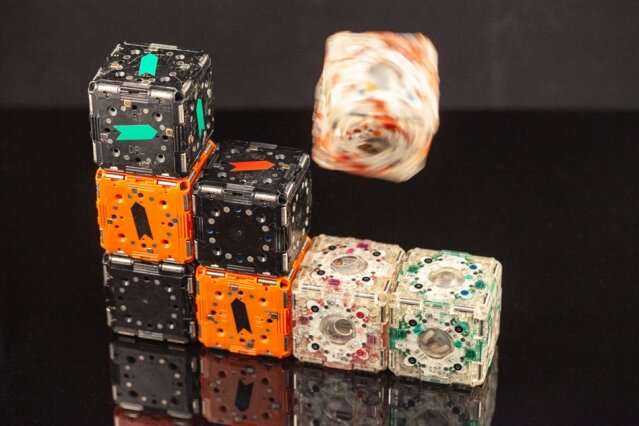 A robotic cube moves into place with rest of the M-Blocks. Source: Jason Dorfman/MIT CSAILA team from Massachusetts Institute of Technology’s (MIT’s) Computer Science and Artificial Intelligence Laboratory (CSAIL) has developed self-assembling, autonomous robotic cubes.
The blocks, dubbed M-Blocks, which have been in development for several years, are capable of climbing, bypassing, rolling and leaping over one another, according to developers. This is accomplished through a network of barcodes affixed to the face of each of the blocks, enabling the blocks to communicate with and to identify each other.
Built into each M-Block are flywheels that enable the blocks to move at roughly 20,000 revolutions per minute (rpm). In addition to the barcodes, fixed magnets also appear on each of the block's faces, enabling the blocks to attach to one another.
The MIT CSAIL team observed that a series of 16 M-Blocks could form lines, follow arrows and track light during the study.
The developers envision that the M-Blocks will find use cases in manufacturing, gaming, health care and disaster relief applications. Specifically, in a disaster relief scenario, the team imagines that blocks might work together to form a staircase in the absence of a staircase burned to the ground or otherwise demolished.
A paper detailing the M-Blocks will be presented at IEEE's International Conference on Intelligent Robots and Systems, which is scheduled for November in Macau.


That was not I recommend you. ipage