
Watch: Gel developed for effective wildfire prevention
S. Himmelstein | October 01, 2019The increasing severity and length of wildfire seasons in California points to the need for effective, long-lasting 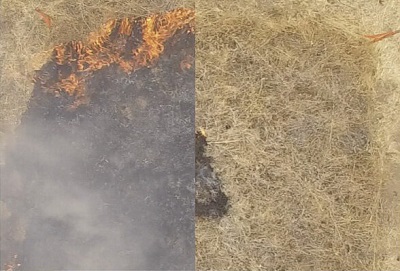 Test burns conducted on a grassy roadside area gauged the effect of the fire-retarding hydrogel. Untreated (left) and treated (right) plots are shown shortly after fire ignition. Source: Eric Appel/Stanford Universityfire suppressants. A cellulose-based gel-like fluid has been synthesized as a non-toxic, long lasting fire retardant that can provide fire protection in treated areas for months.
The fluid serves as a carrier for ammonium polyphosphate (APP), a component widely used in commercial wildland fire-retardant formulations, and is applied using standard agricultural spraying equipment. During burn tests, grass treated with a formulation consisting of 13.5% APP and 85.3% water exhibited no ignition, heat released or mass consumed. Application of the retardant was also shown to provide complete fire protection after half an inch of rainfall.
Different formulations of the new material exhibited enhanced adherence onto vegetation relative to a commercial long-term retardant formulation. A slow degradation rate is predicted to ensure local persistence on vegetation in wildland environments during fire seasons.
The research conducted by scientists from Stanford University, Desert Research Institute and California Polytechnic State University is published in Proceedings of the National Academy of Sciences.

Sounds very good. Now is the time for a large scale demonstration. The only real problem is how do they prove which areas have been treated months down the road?
In reply to #1
Like all other fire retardants used on vegetation, the life span of the retardant, either PhosCheck or gel, used in other aspects of fire suppression does not last longer than a few days or a few hours respectively.
As ammonium phosphate is a fertilizer, it will be absorbed back into the unburnt vegetation and promote future growth.
Sounds great for fire suppression, but do the fauna think it tastes like chicken? Will the animals abandon the area thus contributing to the problem?
Have they tested the effect on wildlife that will consume it for months? How about the hunters that will consume the animals?
It's important as a society that we ask the questions and review the data they used to support the "environmentally benign" comment before implementing a "solution".
In reply to #2
Ammonium Polyphosphate is fertilizer, if anything it will aid in regrowth where flora isn't burnt. They same substance, as quoted in the article, is used in other aspects of fire suppression.
In reply to #2
A simple method of controlling the growth of the burnable material would be the introduction of goats to the area.
There is nothing a goat will not eat.
I have watched 3 goats clear a large wooded lot behind by house as a child in 3 days.
If you have a productive goat herder he could milk the females and produce milk for the children that is better for the children that cows milk.
The heards need to be kept moving north to south or they will eat the bark off the larger trees if they run out of the smaller growths.
Communities could encourage people to use the goats to keep the roadways trimmed and public lands mowed while fertilizing the areas at the same time. It could turn out to be a good employment opportunity. The goats tend to spread out and in wooded areas need a lot of supervision.