
Professor creates a 'laser scarecrow' for warding off birds
Marie Donlon | August 28, 2019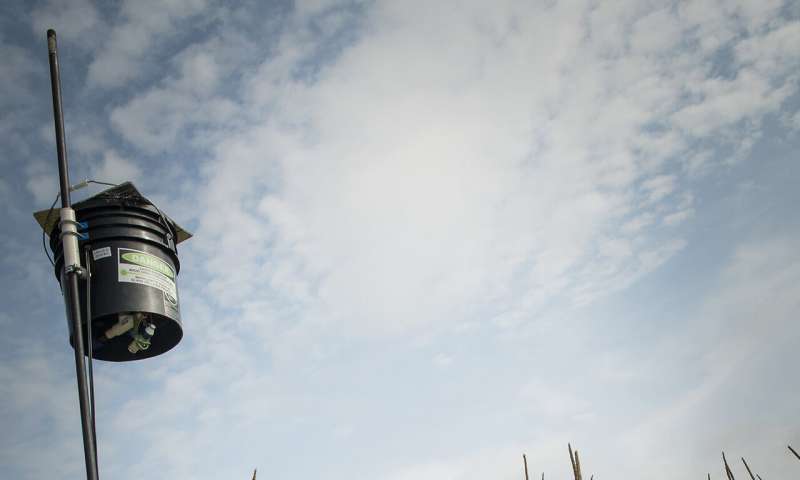 URI professor Rebecca Brown checks out the operation of a laser scarecrow being tested in a cornfield at the URI Agronomy Farm. Source: Nora LewisA professor from the University of Rhode Island has developed a laser scarecrow capable of warding off birds from farmers' crops.
University of Rhode Island plant sciences professor Rebecca Brown devised the laser scarecrow system to help farmers protect crops like sweet corn from being devoured by birds like starlings and red-winged blackbirds.
Professor Brown placed a laser and other electronic components within a five-gallon bucket, which can be raised on a pole, bringing it level to the tassels of corn. Once mounted, the silent green laser emits light from the bucket, automatically moving back and forth across the corn tassels in a field as much as 600 ft across. The constant motion of the laser coupled with the birds’ reported sensitivity to the color green serves to scare the birds away before they are able to attack the ears of corn.
Although lasers have previously been used for bird control efforts, Professor Brown explained that recent developments in technology have made the laser scarecrow possible. Light-emitting diode (LED)-based lasers have become more affordable and can be run using batteries that are now less expensive and more powerful, according to Brown. Likewise, solar panels can be used to charge batteries off the grid.
For the last three years, Brown has been testing the laser scarecrow device at the University of Rhode Island agricultural fields as well as at commercial farms in Charlestown, Cranston, Exeter, Little Compton and Warwick, all in Rhode Island, finding that the device works best on flat fields versus rolling fields because the laser light does not reach every corn stalk when the ground is not level.
"We think the birds perceive the laser as a solid object they need to get away from, but we don't know exactly. We can't get inside the head of a bird," Brown said. "But we know from tests done using hand-held lasers that if the laser isn't constantly moving, the birds will eventually ignore it. It works especially well if there are other sources of food nearby that the birds can go to instead of eating the corn. We're just trying to make the corn less desirable."
In addition to traditional scarecrows, farmers have attempted to warn birds away from valuable crops using other visual deterrents, propane cannons and even shotguns. However, despite those tools, farmers have reported losing as much as roughly 75% of their crop to bird pests, particularly within 48 hours of harvest, according to Brown.
So far, early adopters of the device have already purchased the laser scarecrow from Brown for $500 each. However, Brown hopes that as interest in the device grows, so too will interest from companies who want to manufacture and market it.


Pretty clever. However, crows are pretty smart. I wouldn't be at all surprised if they catch on after a while.