Engineers using lasers to weld ceramics without a furnace
Marie Donlon | August 23, 2019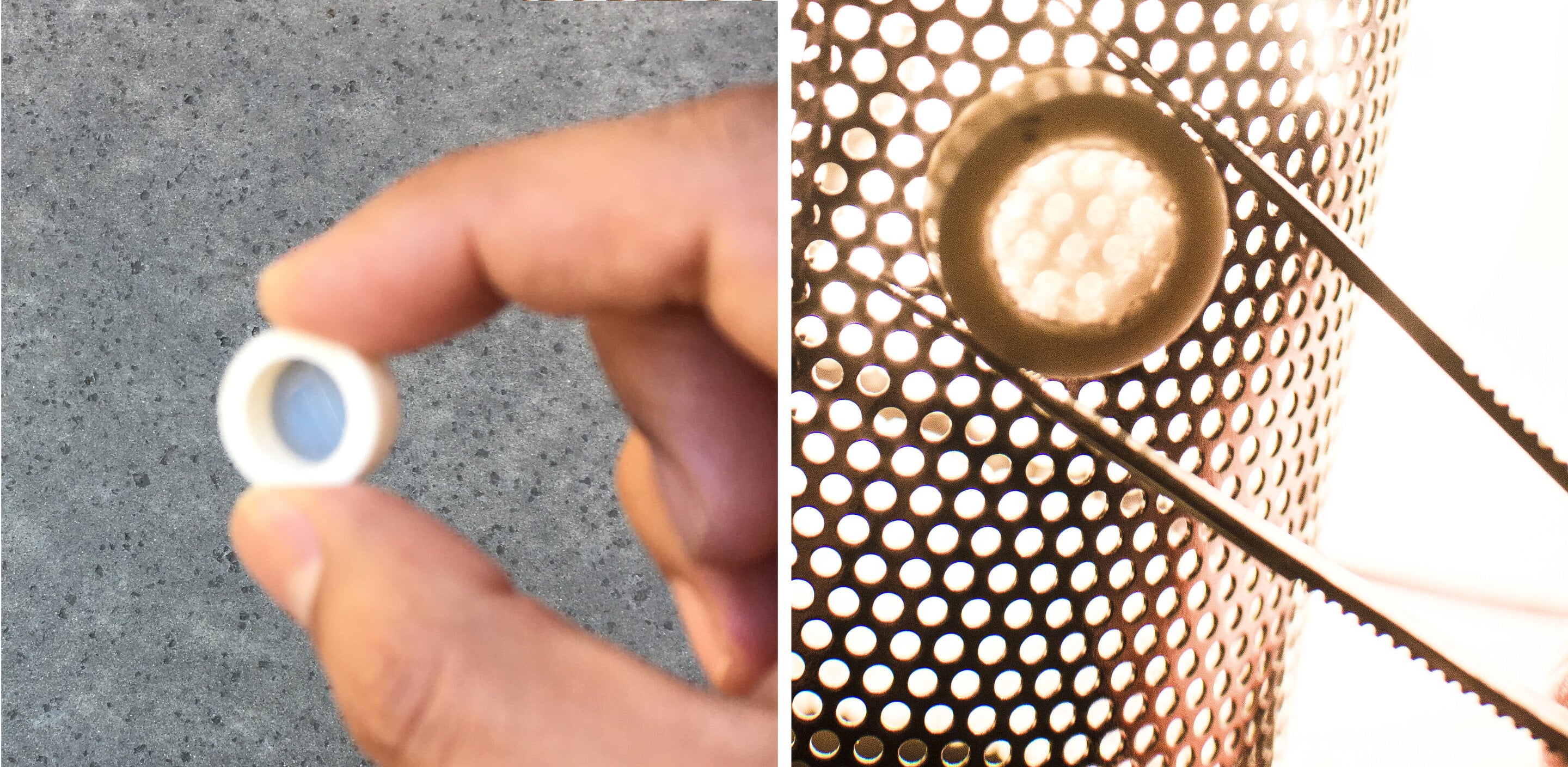 Laser welded ceramic assembly consisting of a transparent cylindrical cap joined to a ceramic tube. Source: Garay Lab/UC San Diego Jacobs School of Engineering
Engineers at the University of California, San Diego, and the University of California, Riverside, have developed a new ceramic welding technique that will potentially pave the way for unbreakable smartphones, metal-free pacemakers and electronics that can withstand the conditions of space and other harsh environments.
Using an ultrafast pulsed laser, the team of engineers was able to melt ceramic materials along their interfaces, fusing them together in a process that has been dubbed ultrafast pulsed laser welding. According to the team, the process requires less than 50 W of laser power and works under ambient conditions, fusing together two ceramic parts by applying short laser pulses along the interface, thereby isolating the heat at the interface without causing localized melting. The new approach, according to the team, is more practical than standard ceramic welding methods that rely on a furnace to heat the components.
Traditionally, ceramics have been difficult to weld together as they require extremely high temperatures in order to melt, which subsequently exposes them to extreme temperature gradients that result in cracking. Yet, because they are biocompatible, shatter-resistant and extremely hard, ceramics are an attractive material for applications such as biomedical implants and for protective electronic casings, according to the team.
Still, developing such devices is challenging using current ceramic welding methods because of the inability to encase or seal electronic components within ceramic, due to the fact that the entire assembly would then have to be placed in a furnace, consequently “frying” the electronics.
To ensure that the new approach would work, the team first had to consider factors such as laser exposure time, number of pulsed lasers to apply and the duration of the pulses along with the transparency of the ceramic materials. The team determined that with the right combination, laser energy would tightly couple to the ceramic, enabling welds to be made with low laser power (under 50 W) and at room temperature.
"The sweet spot of ultrafast pulses was two picoseconds at the high repetition rate of one megahertz, along with a moderate total number of pulses. This maximized the melt diameter, minimized material ablation, and timed cooling just right for the best weld possible," said UC Riverside professor and chair of mechanical engineering Guillermo Aguilar.
"By focusing the energy right where we want it, we avoid setting up temperature gradients throughout the ceramic, so we can encase temperature-sensitive materials without damaging them," explained senior author Javier E. Garay, a professor of mechanical engineering and materials science and engineering at UC San Diego, who led the work in collaboration with Aguilar.
To demonstrate, the engineers welded a see-through cylindrical cap within a ceramic tube. During testing, the welds proved strong enough to maintain vacuum — an industrial measure that ensures seal quality on electronic and optoelectronic devices, according to the team.
So far, the welding process has only been trialed on small ceramic parts less than 2 cm in size. Eventually, the team plans to apply the process to larger-scale parts.
The team detailed their work in the journal Science.