Color-changing tattoos serve as diagnostic displays
S. Himmelstein | July 25, 2019An international research team has developed a dermal-biosensor system in the form of tattoos. These monitor glucose, pH and other parameters in interstitial fluid. The specially formulated pigments injected into the skin 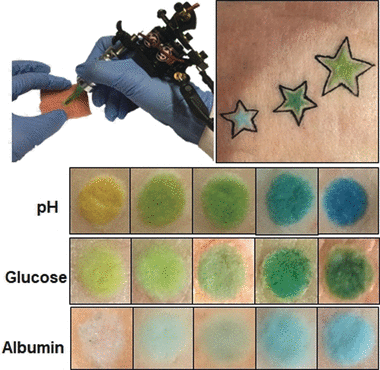 The colorimetric tattoos were injected into pig skin patches. Source: Wiley-VCHchange color to signal the status of a specific health condition.
Three permanent colorimetric chemical sensors were designed to produce a color change in response to biomarkers. A minimally invasive, dermal pH sensor based on methyl red, bromothymol blue and phenolphthalein responded to a pH increase from 5.0 to 9.0 by converting from yellow to blue. Another dermal sensor transforms from yellow to dark green as rising glucose levels interact with an organic pigment, and a yellow dye-based biosensor goes green upon exposure to albumin protein.
The tattoos were tested on patches of pig skin and quantitative readouts were obtained using a smartphone camera. With additional refinements, the tattoo technology could also be applied to inexpensively monitor electrolyte and pathogen concentrations or hydration levels.
Researchers from Technical University of Munich, University of Birmingham (U.K.), Harvard University, University of California Davis and Khalifa University (Abu Dhabi) contributed to this development.
Discussion – 1 comment