Walk and harvest energy with this backpack
S. Himmelstein | July 15, 2019Portable electronics used by military or disaster relief personnel, people in remote areas or just about anyone 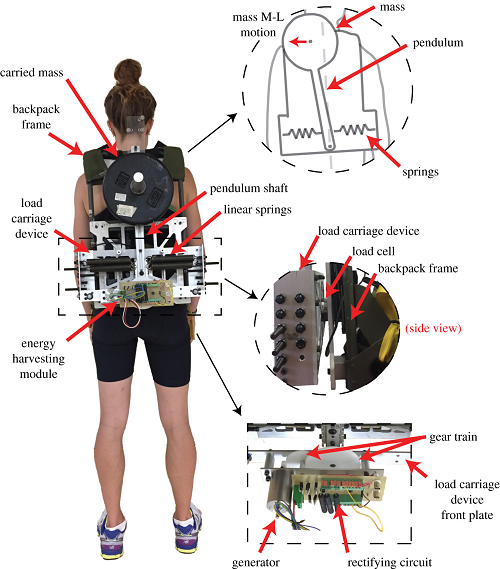 Posterior view of the energy harvesting backpack worn by a subject. Source: Royal Society Open Sciencecan be powered or charged simply by walking, provided the walker wears a biomechanical energy harvester engineered at Queen's University, Canada. Contained in a backpack, the energy harvesting load carriage system generates electricity from the side-to-side movements of a person walking.
An inverted pendulum with cylindrical weights attached is linked to an electromagnetic generator by a two-stage gear train and linear springs. The gears use the swinging motion of the pendulum to drive the generator, which produces electricity to power portable electronics.
The initial weight of the backpack-encased load carriage device was 11 lb. During walking tests, an additional 9 lb of weight enabled the system to generate 0.22 W, sufficient to power small portable electronic devices. Adding 35 more pounds of weight allows the device described in Royal Society Open Science to generate enough electricity to power a smartphone.
The researchers will next address reducing the mass of the energy harvesting backpack system to lower carrying costs associated with walking with the device.