
Celebrate 7.5 billion on World Population Day
S. Himmelstein | July 11, 2019Celebrate World Population Day today, July 11, with 7.58 billion others currently sharing the Earth. The annual 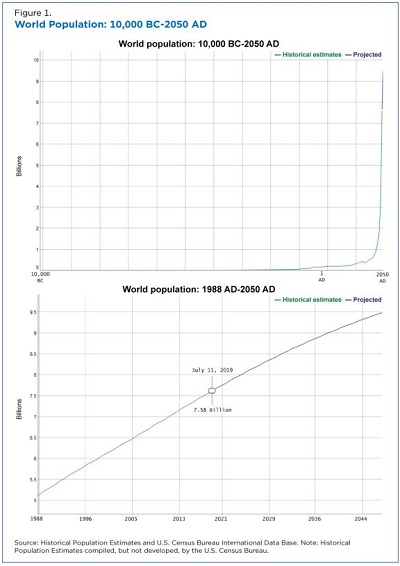 Source: U.S. Census Bureau International Databaseevent was established by the U.N. Development Programme in 1989 to focus attention on sustainability and the socioeconomic issues associated with population growth.
The U.S. Census Bureau estimated that global population has increased by more than 50% in the 32 years since the 5 billion mark was passed in 1987. Annual population growth will slip under 1.0% in 2020-2021 for the first time since 1950 due to declining trends in global total fertility rates. New projections indicate that the 8 billion mark will be reached in 2025 and 8.5 billion by 2030.
China, India and the U.S. are expected to remain the nations with the largest populations, although their growth rates are not among the fastest. According to data recently released by the Population Reference Bureau, that distinction belongs to 20 countries in Africa and Asia, where populations have surged in recent years. The rapid population growth is expected to continue into 2050, fueled by increased life expectancy and declining mortality and high fertility rates associated with a largely youthful – and booming – population.
Keep tabs on population numbers in the U.S. and globally by viewing the U.S. Census Bureau population clock.



In the US...
One birth every 8 seconds
One death every 12 seconds
One international migrant (net) every 34 seconds
Net gain of one person every 14 seconds
86,400 seconds a day...6,172 people per day ~ 2.25 million per year
US current pop est 329,225,545
So, when does SOYLENT GREEN become real?
In reply to #2
It's already started....this is the first step...
https://www.pri.org/
In reply to #5
Second step....
https://insights.glo
In reply to #6
Step three...The Zombie apocalypse....
Steps one and two produce prion loops, which feed back into the food chain....The effect is unnoticed at first, but the contamination level continues to grow quietly for many years until it reaches a critical level that begins to effect younger and younger people, at this stage it is irreversible and dementia becomes widespread...Society
In reply to #8
The streets are already filled with zombie like people stumbling around aimlessly ( staring onto cell phones texting to unknowns while stepping off curbs into speeding traffic ).
More people, more wars, more traffic jams.
Not exactly a reason to celebrate.
In reply to #3
More wars equal less people and less traffic jams.
Sustainable, doubtful. Celebration, hardly. A species with population growth rate that's out of control, quite indubably. We need to wise up collectively and arrive at a number(population) that this planet can support. Like any finite resource, this can be managed by educated people determining how well our lovely planet is able to replenish itself. Is this a priority on the minds of people that are bickering and mostly driven by greed and power, never!
In reply to #4
I remember when they said the Earth couldn't sustain 4 Billion people in the late 70's, but it did, and then 5 Billion was going to be impossible in the 80's, but it did, and so on and so on.
A study was done in the late 70's that showed if every body in the world was part of a family of 4 people and each family was given 5 acres of land, then the entire world population could fit in the size of the United States.
It appears that humans are able to adapt and become more inventive as challenges are found.