Watch: Tiny camera captures polarization, expands reality
Amy J. Born | July 09, 2019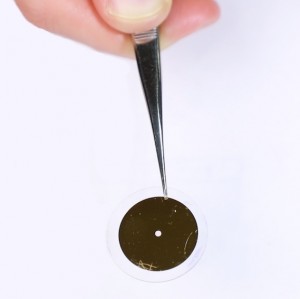 The portable polarization camera is about two centimeters in diameter and uses a metasurface with an array of subwavelength spaced nanopillars to direct light based on its polarization. Source: Eliza Grinnell/Harvard SEASCertain species of shrimp and insects are able to see light in a way that is invisible to the human eye. The direction in which light vibrates, known as polarization, provides information that, among other things, helps them defend against predators, and has potential applications in a number of fields.
Until now, polarization-sensitive cameras have been large, bulky and expensive, which limits their usefulness. However, researchers at the Harvard John A. Paulson School of Engineering and Applied Sciences (SEAS) have developed a compact, portable version that, according to SEAS, "can image polarization in a single shot."
Federico Capasso, professor of applied physics, a senior electrical engineering research fellow at SEAS and senior author of the paper, explained, “Most cameras can typically only detect the intensity and color of light but can’t see polarization. This camera is a new eye on reality, allowing us to reveal how light is reflected and transmitted by the world around us.”
Polarization is a quality of light, like color and brightness. It can reveal hidden features such as texture that would not be visible in a regular photograph and, according to Paul Chevalier, a postdoctoral fellow at SEAS and co-author of the study, changes as it is reflected off a surface. "Based on that change, polarization can help us in the 3D reconstruction of an object, to estimate its depth, texture and shape, and to distinguish man-made objects from natural ones, even if they’re the same shape and color,” he said.
The thumb-sized camera can be used to enhance the vision systems of autonomous vehicles, to study atmospheric chemistry onboard planes or satellites or to detect camouflaged objects. In tests, the researchers were able to show defects in injection-molded plastic objects, capture the polarization off car windshields and demonstrate the camera's ability to visualize the 3D contours of a face.
 Source: SEAS
Earlier cameras required moving parts to capture polarization. SEAS reported that Capasso's team "designed a metasurface that uses an array of subwavelength spaced nanopillars to direct light based on its polarization." Four images, each showing a different aspect of the polarization, are combined to create a complete snapshot of polarization at every pixel.
The research is published in Science.