Research effort will focus on 3D printing with wood
Engineering360 News Desk | July 01, 2019Oak Ridge National Laboratory (ORNL) and University of Maine (UMaine) researchers will collaborate on a large-scale bio-based additive manufacturing program, also known as 3D printing.
The collaboration is intended to advance efforts to 3D print with wood products. The work could create a new market for additive manufacturing and Maine’s forest products industry.
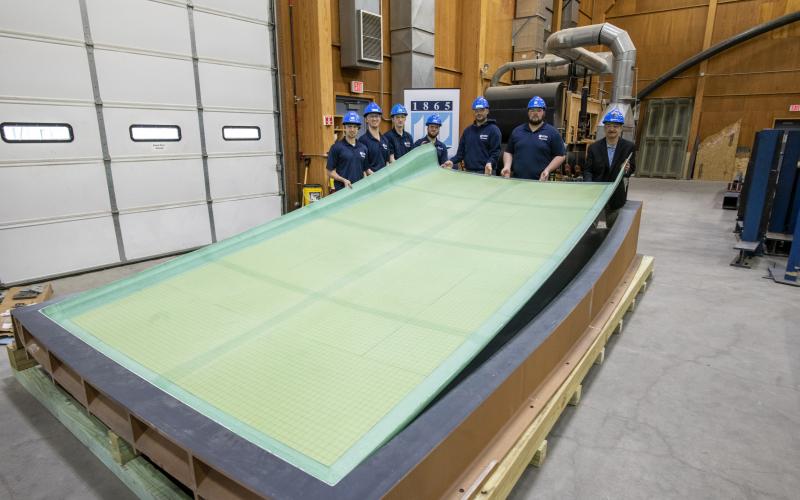 Researchers collaborated to 3D print a large-scale mold from bioderived materials. This mold is being used to fabricate the top of a yacht and was made from wood flour, cellulose nanofibrils and PLA. Source: ORNLFunded by the Department of Energy's (DOE's) Advanced Manufacturing Office, the bio-based additive manufacturing program will offer students, faculty and companies associated with UMaine’s Advanced Structures and Composites Center access to Oak Ridge assets in advanced manufacturing at DOE’s Manufacturing Demonstration Facility. ORNL researchers will gain access to UMaine’s expertise in cellulose nano fiber and composites.
Scientists will conduct fundamental research in several key areas, including cellulose nano fiber (CNF) production, drying, functionalization and compounding with thermoplastics, multi-scale modeling and sustainability life-cycle analysis. By placing CNF into plastics, strong, stiff and recyclable bio-derived material systems may be developed that can be 3D printed at deposition rates that could reach hundreds of pounds per hour and with up to 50% cellulose fiber loading.
Printing with 50% wood could open new markets for pulp, fiber and forest products industries. A statement from Oak Ridge said that as a forest product, CNF "could rival steel properties" and that its successful incorporation into plastics "shows great promise for a renewable feedstock suitable for additive manufacturing."
The research team will work with the forest products industry to produce new bio-based materials that will be conducive to 3D printing large-scale products such as boat hull molds, shelters, building components, tooling for composites and wind blades. The collaboration will position the industry to print large, structurally demanding systems, such as boats.