Researchers develop food sensors with potential for replacing "use-by" dates
Marie Donlon | June 06, 2019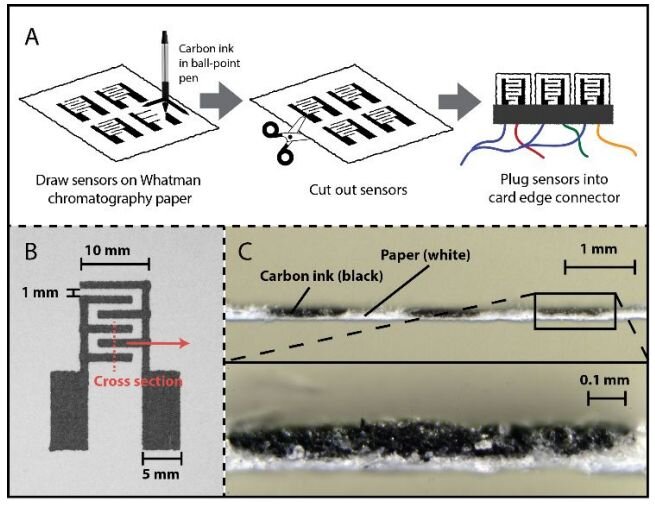 (A) Fabrication of paper-based electrical gas sensors (PEGS). Carbon electrodes are printed on cellulose chromatography 1 paper with a ballpoint pen and cutter plotter, allowing rapid prototyping in the desired geometry. Once printed, the sensors are cut and placed inside a card-edge connector for characterization. (B) Top-view of a single PEGS consisting of two electrodes with three fingers and a spacing of 1 mm in between each finger. (C) Cross-section of a PEGS across three fingers (red dashed line in B). Carbon ink (black) partially penetrates paper (white). Source: ACS Sensors (2019). DOI: 10.1021/acssensors.9b00555
In an effort to cut food waste, researchers from the Imperial College London have developed sensors capable of detecting spoilage in meat and fish products.
Called paper-based electrical gas sensors (PEGS), the sensors can detect gases such as trimethylamine and ammonia, which can signal spoilage in meats and fish. The developers made it possible for the sensor data to be read by mobile phone, enabling consumers to determine the safety of their food via smartphone scan.
To create the sensors, the research team printed carbon electrodes onto cellulose paper. Using biodegradable materials, the researchers ensured that the sensors could safely be used in food packaging, as they are ecofriendly and non-toxic. Working in combination with near-field communication (NFC) tags, the sensors developed at Imperial College London could one day replace traditional “use-by” dates as the sensors demonstrated during testing that they could detect trace amounts of spoilage gases in packaged fish and chicken.
Although there are other food freshness sensors already in development, researchers are calling PEGS the “first ever commercially viable food freshness sensors” as the sensors are inexpensive to develop (two cents per sensor).
Lead author Dr. Firat Güder, of Imperial's Department of Bioengineering, said: "Citizens want to be confident that their food is safe to eat, and to avoid throwing food away unnecessarily because they aren't able to judge its safety. These sensors are cheap enough that we hope supermarkets could use them within three years.”
Dr. Güder added: "We believe our very simple technique could easily be scaled up to produce PEGS on a mass scale by using existing high-volume printing methods such as screen printing and roll-to-roll printing."
In addition to food packaging applications, the research team envisions that the sensors could be used to help detect chemicals in agriculture, air quality or in disease detection. In the meantime, the researchers intend to apply the sensors to other types of food through an array of PEGS where each sensor is capable of detecting a different chemical.
The research appears in the journal ACS Sensors.