Team develops hand-held scanner capable of detecting hazardous substances
Marie Donlon | June 03, 2019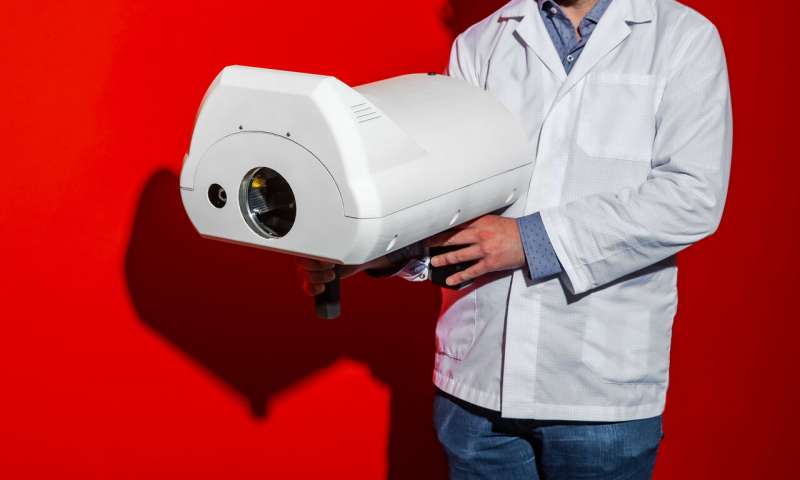 Source: Fraunhofer Institute for Applied Solid State Physics IAF Researchers at the Germany-based Fraunhofer Institute for Applied Solid State Physics IAF have developed a hand-held scanner capable of detecting hazardous substances.
The scanner’s sensor can detect explosive, toxic and other dangerous substances in real-time, assisting emergency personnel with immediate detection at the scene of a crime or following a terrorist attack or an accident at an industrial plant where chemicals spread in an unpredictable way. Such an analysis would typically be a time consuming one considering that the process generally involves samples taken from the scene and sent to an off-site laboratory. Using the hand-held scanner, however, will likely expedite the process, according to the research team, enabling emergency personnel to respond almost immediately.
To develop the hand-held scanner, researchers created a measuring device inspired by infrared backscattering spectroscopy. This combines extremely fast tunable quantum cascade lasers with adjusted transmission and receiver optics, control and detection software, and fast infrared detectors.
"Such devices need to compensate the inevitable movements of the hand and still be able to detect a conclusive spectrum within a short amount of time. Together with Fraunhofer IPMS, we have developed a miniaturized quantum cascade laser with an external resonator that is able to scan the whole spectral range of the QC laser chip within just a millisecond," explained Dr. Stefan Hugger, project manager and scientist at Fraunhofer IAF.
Measurement relies on selective spectral lighting of the target in the wavelength range of 1000 to 1300 cm-1, according to researchers. The presence of the chemical substance is determined by backscattered light intensity and illumination wavelength. A “spectral fingerprint” is then matched with the integrated database, which houses a significant amount of safety-relevant substances, thereby making substance identification immediate and precise.
During testing, the scanner reportedly detected several explosives as well as their precursor materials. The team intends to increase the measurement system, making the device appropriate for every-day use.