Hydropower project funding announced by DOE
S. Himmelstein | April 05, 2019Cost-containing technologies with potential to expand new stream-reach and pumped storage hydropower (PSH) developments have been granted $7.5 million in U.S. Department of Energy funding.
The funding selections focus on innovative designs for small, low-head hydropower facilities capable of reducing capital costs and environmental impacts of development at new stream-reaches. Other projects are based on scientific analyses designed to demonstrate how PSH can optimize the performance of the U.S. electric grid 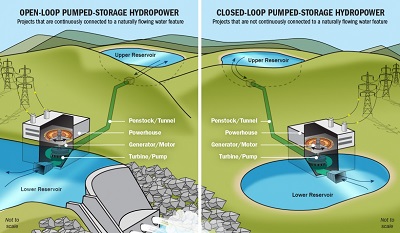 Illustration of open-loop and closed-loop pumped storage hydropower systems. Source: U.S. Department of Energysystem to lower overall system costs.
A new foundation module is being designed by Massachusetts-based funding recipient Littoral Power Systems. Engineers will use 3D contouring to ensure compatibility of a precast foundation with the streambed and minimize environmental impacts during construction. Similarly, Natel Energy of Alameda, California, will advance a modern low-head hydropower technology that also utilizes best practices of stream restoration and whitewater recreation.
A conceptual system proposed by University of Utah researchers will explore the possibility of using existing large water storage tanks for distributed PSH by installing secondary storage tanks in locations with elevation differences to help enable electric utilities and water/wastewater districts to cost-effectively develop energy storage capabilities. A bi-directional injector-generator for a geo-mechanical pumped storage operation is being developed by Quidnet Energy Inc. of Houston, Texas, to store energy by pumping water into existing rock fissures at high pressures. The system operates at higher temperatures than traditional PSH and achieves 95% mechanical efficiency.
Modeling studies conducted by Missouri University of Science and Technology, the Electric Power Research Institute and General Electric will seek to optimize the contributions of PSH technology to the electric grid.