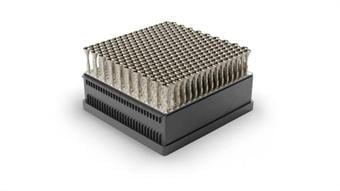
This scanner technology may speed up airport security lines
David Wagman | March 22, 2019A flat panel solid-state millimeter wave imaging system for use at airport security screen checkpoints has been installed at Denver International Airport.
The Rohde & Schwarz R&SQPS201 system was purchased by the airport and deployed to demonstrate next-generation security technology. The unit has been operational since late 2018.
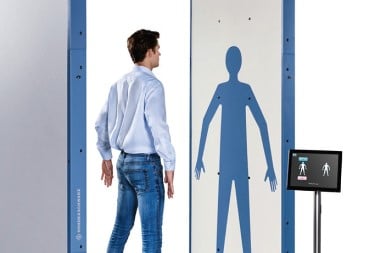 Passengers stand between flat panels for screening. Source: Rohde & SchwarzThe scanners have been used elsewhere around the world since 2015. The device reportedly has achieved TSA and European Civil Aviation Conference (ECAC) Advanced Imaging Technology (AIT) detection certifications.
The security scanner uses millimeter wave radio frequency technology to screen passengers for concealed threats. The scan requires around 64 milliseconds to complete and delivers results to security personnel in around 2.5 seconds.
The technology provides detection capability of both metallic and nonmetallic materials with what the company said is a higher probability of detection (Pd) and lower probability of false alarm (Pfa). This combination may reduce the need for secondary screening and alarm resolution procedures.
 Security screeners can easily see if a passenger requires secondary screening. Source: Rohde & SchwarzIn practice, a security operator can determine if secondary screening is required based on the alarm location shown on an avatar. Secondary screening can be streamlined by using multiple resolution stations, which allows the scanner to continue scanning and maintain a forward flow. The company said that up to 900 people an hour can be scanned by a single checkpoint.
The system consists of two flat panels. Passengers to be screened enter between the panels and face one of them, like standing in front of a mirror, their arms slightly held away from the sides. Passengers with hip/knee replacements, metal pins and other implants no longer need to go through special screening since the test system signals do not penetrate the human skin.