Flexible membranes are key to new wave energy system
S. Himmelstein | February 20, 2019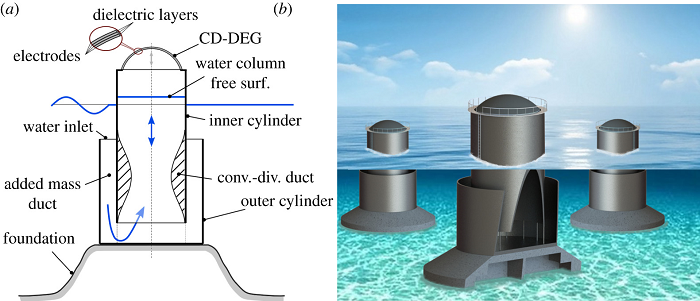 (a) Schematic of the DEG system. (b) Artistic impression of a DEG farm and detail of the internal structure of the collector. Source: Universities of Trento, Bologna and Edinburgh and Scuola Superiore Sant'Anna Pisa
A new durable wave energy conversion system was designed to incur lower costs and to incorporate fewer moving parts relative to existing converters. The Dielectric Elastomer Generator (DEG) is envisioned for integration with or as a replacement for existing ocean energy systems to convert wave power into electricity.
The DEG sits on a vertical tube that partially fills with water due to wave motion. The water inside pushes the trapped air above to inflate and deflate flexible rubber membranes on top of the device as waves pass the tube. Voltage is generated with both membrane inflation and deflation, due to the use of dielectric material in the DEG structure. The power produced can be transmitted to shore via underwater cables.
A small-scale prototype was successfully tested in a 25-m-diameter circular wave tank and generated a peak power output of up to 3.8 W. Based on the results, engineers estimated that a full-size device could generate the equivalent of 500 kW of electricity, sufficient to power about 100 homes.
Scientists from University of Trento (Italy), University of Bologna (Italy), Scuola Superiore Sant'Anna Pisa (Italy) and University of Edinburgh contributed to this research, which is published in Proceedings of the Royal Society A.