Renewables drive utility market for reciprocating engines
David Wagman | February 19, 2019Reciprocating internal combustion engines are becoming increasingly popular for larger utility-scale power generation applications, according to the Energy Department's Energy Information Administration (EIA).
The equipment is especially popular in areas with high levels of electricity generation from intermittent sources such as wind and solar.
 The increase in natural gas or dual-fuel-capable reciprocating internal combustion engine units has been driven in part by advancements in engine technology that increase operational flexibility and by changes in natural gas markets that have generally provided ample supply and relatively stable fuel prices.
(Use Engineering360 to learn more about engineering standards applicable to industrial-scale reciprocating engines.)
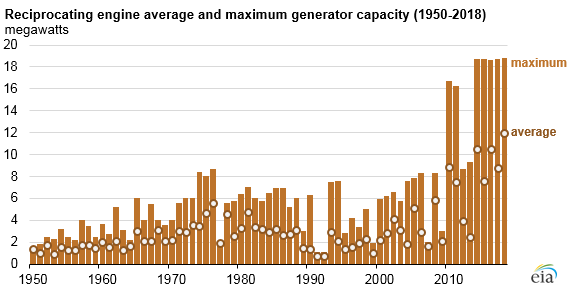
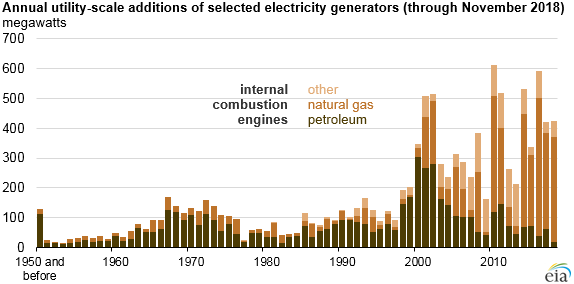 Source: EIAEIA said that reciprocating engines tend to be smaller than other types of natural gas-fired electricity generators. They also make up a relatively small share of power plants fueled by natural gas. As of November 2018, the capacity of the average reciprocating engine generator was 4 megawatts (MW), compared with 56 MW for natural gas combustion turbines and 166 MW for combined-cycle units. Reciprocating engines accounted for 1% of the total natural gas-fired power fleet.
 Engine hall at the Denton Energy Center: Source: Denton city utilitiesBefore 2010, reciprocating engines typically had no more than 9 MW in capacity. More recently, units as large as 19 MW have been installed. Several of these engines are typically installed at one generation facility.
Reciprocating engines for Denton
One of the largest is the Denton Energy Center, which came online in July 2018 near Dallas, Texas. It has a dozen 18.8 MW natural gas-fired engines for a total plant capacity of 225 MW.
Engineering firm Burns & McDonnell provided environmental and air permitting and engineer-procure-construct (EPC) services for the Denton project, which includes the Wärtsilä 18V50SG reciprocating engine technology.
 Source: EIAThe municipal utility aims to provide its members with approximately 70% renewable energy in 2019. Due to supply fluctuations from renewables, the Denton Energy Center will be used to follow the renewable load and stabilize the grid. Each Wärtsilä engine can be dispatched independently to scale output up or down. The uses selective catalytic reduction to minimize pollutants. (See engineering standards at Engineering360 that apply to selective catalytic reduction technologies.)
Backup for intermittent wind and solar
The EIA said that a main advantage of reciprocating engines is their ability to provide incremental electricity quickly. Because these units can start and stop quickly and operate at partial loads, they have become increasingly important in areas with high shares of renewable electricity generation from wind and solar.
Reciprocating engines can start up even when the grid has no power. This helps electric transmission grid operators match fluctuating power requirements and restore power after major storms. Engine manufacturers have also made advances in efficiency and emission reductions, particularly emissions of nitrogen oxides (NOx). In addition, power plants using internal combustion engines tend to require less water than similarly sized combined-cycle or simple-cycle natural gas turbine plants.
Texas, which has the most wind electricity generation capacity in the country, has 910 MW of natural gas-driven reciprocating engines, or 20% of the national total (4,642 MW). Kansas (564 MW) and California (398 MW), both states with large amounts of renewable generation, have the next highest capacities of reciprocating engines, EIA said.
In addition to the Denton Energy Center, Texas is home to three other facilities that rank among the six largest reciprocating engine plants in the United States:
- Red Gate Power Plant, located near McAllen, is a 220-MW plant that became operational in 2016. This plant features 12 natural gas-fired reciprocating engines, each providing 18.3 MW of capacity.
- Pearsall Power Plant, located near San Antonio, is a 202-MW plant equipped with 24 natural gas-fired reciprocating engines, each providing 8.4 MW of capacity. The plant came online in 2010 and can provide 25% of total generating capacity within two minutes and reach full output within eight minutes.
- Antelope Station is a 164 MW plant near Lubbock. The plant started commercial operation in 2011 and consists of 18 reciprocating engine generators with 9.1 MW capacity. Each can achieve full output in five minutes.