Researchers create self-healing 3D-printed material
Marie Donlon | February 06, 2019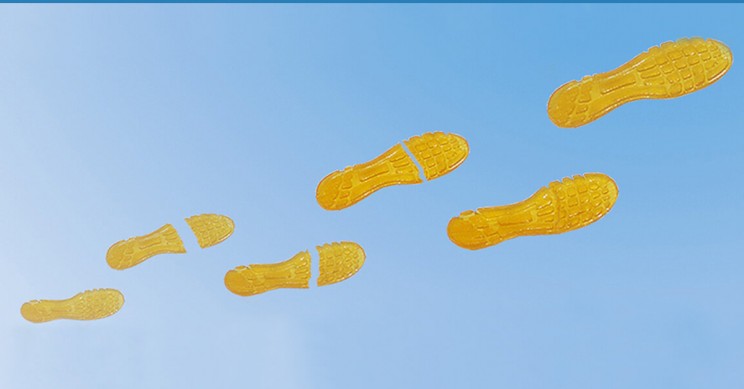 Source: An Xin and Kunhao Yu/USCResearchers at the University of Southern California Viterbi School of Engineering have been developing material that could make worn shoes and flat tires a thing of the past.
According to researchers, the 3D-printed rubber material can self-repair through a 3D-printing process called photopolymerization, which is a technique that relies on either visible or ultraviolet light to harden liquid resin. Photopolymerization occurs through a reaction to a chemical group known as thiols. By introducing an oxidizer to the equation, the thiols are transformed into disulfides, which are members of a self-repairing chemical group.
To achieve self-healing abilities, the research team had to discover the correct ratio between the thiol and the disulfide groups. If the oxidant is increased, the self-healing behavior becomes stronger, although photopolymerization is weaker.
As a result, the speed of printing with the rubber material has been increased, enabling researchers to print a 17.5-millimeter square in five seconds and whole objects in roughly 20 minutes. Additionally, it only takes a few hours for the materials to repair themselves, according to the team.
To demonstrate applications in different industries, the team used the material on items such as a soft robot, a shoe pad, a multiphase composite and an electronic sensor. After cutting each item in half, researchers reported that all four objects healed themselves in under four hours.
"We actually show that under different temperatures — from 40 degrees Celsius to 60 degrees Celsius — the material can heal to almost 100 percent," said Kunhao Yu, who was the first author of the study. "By changing the temperature, we can manipulate the healing speed, even under room temperature the material can still self-heal."
Currently, the team is working on self-healing material with different rigidity, so that the material will be appropriate for additional applications.
The research is published in NPG Asia Materials.