An app to predict species extinction risk
S. Himmelstein | February 04, 2019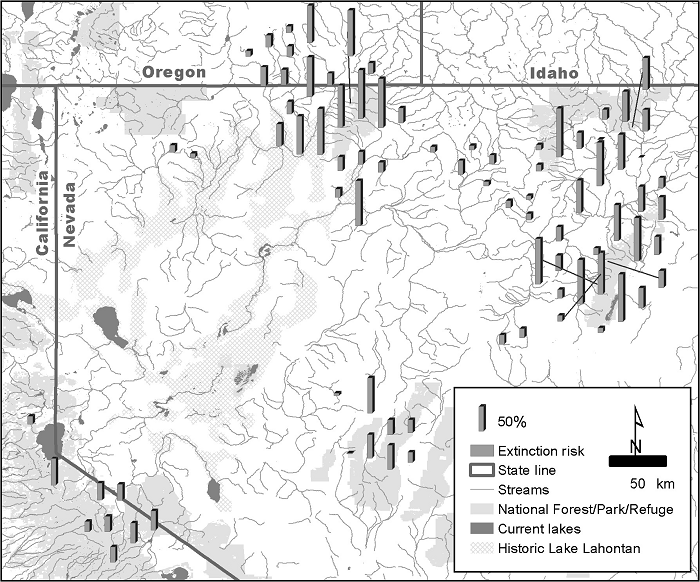 Map of extinction risks for current Lahontan cutthroat populations. Source: Ecological Society of America
Conservation biologists are advancing a species-specific method of risk assessment to determine the probability that a population will become extinct within a given timeframe. Unlike available population viability analysis methods, the new modeling scheme does not require an enormous amount of long-term data for every population of interest throughout a species’ range.
Biologists are applying the hierarchical multi‐population viability analysis model to improve management of the Lahontan cutthroat trout, a federally listed threatened species in the western U.S. The approach shares data among populations to assess extinction risk by combining process, sampling and observation models.
Process models estimate year-to-year changes in a local population based on reproductive potential, environmental conditions and other parameters. Sampling models use information from a few survey sites to estimate the total population size, including all the individuals in never-sampled areas. Observation models estimate how many individuals were missed when sampling at each survey site. Together, these analyses allow the model to tie site-level data to population-level outcomes.
An accompanying web app allows users to browse a map, select a stream and view estimates of its Lahontan cutthroat trout population, and to forecast simulations under changing habitat conditions. Analysis of trout in the Great Basin area of California, Nevada and Oregon shows that population growth rates were higher in colder streams and that non-native trout reduced carrying capacities of native trout.
Researchers are already adapting the model for use in other contexts, including the development of models to map human populations in places without regular census counts.
Researchers from the University of Georgia, U.S. Geological Survey, Trout Unlimited, University of Nevada and U.S. Forest Service contributed to this study, which is published in Ecology.