New parallel photoreactor for small-scale photocatalysis reactions
Shawn Martin | January 31, 2019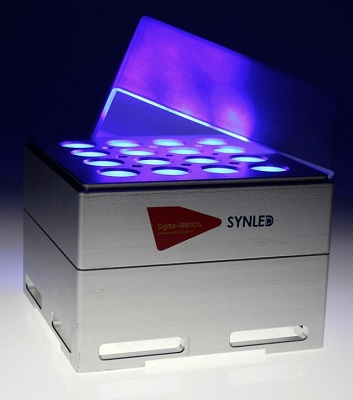 Source: Millipore Sigma
A new laboratory-grade photoreactor offers improved repeatability when performing small-scale photocatalysis reactions. Millipore Sigma, formerly Sigma-Aldrich, claims that their device provides for higher levels of consistency due to improved thermal management and greater light intensity consistency.
The Syn LED parallel photoreactor is provided with bottom-lit light-emitting diodes (LEDs) that emit a wavelength of 465 to 470 nm at an angle of 45° with a light intensity of 130 to 140 lumens. The device offers highly consistent illumination across its entire 4 x 4 reaction block, while the built-in cooling fan and heat sink normalize the thermal gradient, keeping the entire reaction block at approximately 30° C.
Photoredox catalysis
Millipore Sigma states that photoredox catalysis has provided significant value in organic synthesis. It allows for forging of new bonds via open shell pathways and facilitates assembly of complex products. Transition-metal complexes and organocatalysts have proven to initiate radical formations including cross-coupling, C-H functionalization, alkene functionalization, arene functionalization and trifluoromethylation in the presence of visible light, but reproducibility has been challenging.
Millipore Sigma’s new Syn LED parallel photoreactor was developed to address challenges in organic synthesis repeatability. The company said the device enables small-scale photocatalysis reaction screening and rapid library generation with improved consistency across the reaction block and between batches.
The photoreactor supports 16 vials with an outer diameter of 1.7 cm or less. Each well is illuminated by a 1 W blue LED centered at 467.5 nm which is equipped with a 45° lens. The device is also compatible with the IKA RCT basic IKAMAG safety control universal hot plate magnetic stirrer.