
Facing billions in potential liabilities, PG&E files Chapter 11
David Wagman | January 29, 2019As expected, PG&E Corp. and its utility, Pacific Gas and Electric Co., filed voluntary petitions on Jan. 29 under Chapter 11 of the U.S. Bankruptcy Code in the U.S. Bankruptcy Court for the Northern District of California.
The company faces an estimated $30 billion in potential liability for wildfires in 2017 and 2018. Those fires may have been caused by equipment operated by the company. More than 100 people died and thousands of structures were destroyed, including much of the city of Paradise, California, which burned in November 2018 as part of the Camp Fire.
 In its bankruptcy reorganization filings, PG&E filed a legal motion seeking approval for $5.5 billion in what is known as debtor-in-possession (DIP) financing with J.P. Morgan, Bank of America, Barclays, Citi, BNP Paribas, Credit Suisse, Goldman Sachs, MUFG Union Bank and Wells Fargo acting as joint lead arrangers.
The DIP financing, if approved, would provide PG&E enough capital to ensure essential maintenance and continued investments in safety and reliability for the expected duration of the Chapter 11 process.
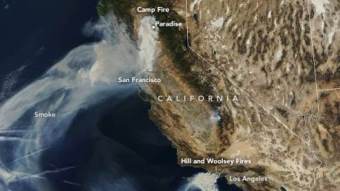 In this November 2018 image from space, the Camp Fire burns in northern California. Source: NASAThe company also asked for court approval to continue paying employees and providing healthcare and other benefits. In the filings, PG&E also asked for authority to continue existing customer programs, including low-income support, energy efficiency and other programs supporting customer adoption of clean energy. The company said it also intends to pay suppliers in full under normal terms for goods and services provided on or after the bankruptcy filing date.
(Read "Challenged by crisis, the electric grid decentralizes.")
On Jan. 24, California's lead fire agency found that the 2017 Tubbs Fire was not caused by PG&E equipment. The fire agency is continuing its investigation into the cause of the Camp Fire, which is believed to have ignited near utility-owned electric transmission lines.



Huge schools of lawyers have been spotted circling off the coast of California . . .