
PG&E plans Chapter 11 as it eyes possible fire liabilities
David Wagman | January 14, 2019Facing possible liabilities that could top $30 billion for wildfires in 2017 and 2018, California-based PG&E Corp. said that it could file for Chapter 11 bankruptcy reorganization protection as early as January 29.
The company made the announcement January 13 as part of a required 15-day advance notice. It also said that Geisha J. Williams stepped down as CEO and president of the corporation and resigned from the boards of directors of the corporation and its utility, Pacific Gas & Electric Co. John R. Simon, executive vice president and general counsel, was named interim CEO.
 In its filing with the U.S. Securities & Exchange Commission, the company said that it faces "extraordinary challenges" as a result of the wildfires that hit Northern California over the past two years. It said that reorganizing under the protection of Chapter 11 of the U.S. Bankruptcy Code was "the only viable option."
(Read "PG&E offers details on equipment failures near Camp Fire.")
The company said it does not expect any impact to electric or natural gas service for customers as a result of the reorganization process.
The utility serves 16 million customers across a 70,000-square-mile service area in northern and central California. Many of its assets, including electricity transmission towers and substations, are located in remote and hard-to-reach parts of the state.
Shift to decentralization
The far-flung nature of PG&E's service territory is not unusual in the western U.S. where load centers are often separated by long distances. Steady investments of the year by investor-owned utilities such as PG&E, as well as public power entities and the U.S. government, through ventures such as the Bonneville Power Administration and Hoover Dam, have resulted in long-haul transmission networks all across the region.
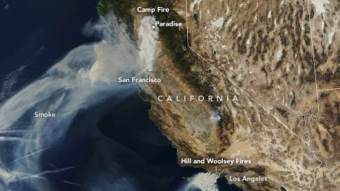 As seen from space, two major wildfires burn in California during November 2018. Source: NASAThe U.S. electric power grid is undergoing a slow but steady shift to decentralization. The change is altering the nature of the grid’s century-old structure that has been hailed as one of the world’s largest interconnected systems of machines.
Industry experts say that the change is being driven by large-scale trends that include technology innovations such as energy storage and solar photovoltaics, government policy changes that encourage distributed generating resources and seek to decarbonize the economy, and consumer behavior that is blurring traditional definitions of producers and consumers.
The changes are coming with a sense of urgency as disasters that range from the wildfires that have hit the west to hurricanes and flooding in the east. Vulnerabilities are being exposed in a grid that long has been built around the concept of centralized power plants and extensive networks of transmission and distribution lines.
Consider these examples:
- Puerto Rico’s power grid was largely destroyed in 2017 when Hurricane Maria swept across the island. The storm largely wiped out transmission lines that connected generating resources located on the south side of the island with load centers on the north. In what is regarded as the largest power failure to hit the U.S., service to many parts of the island was not restored for months after the storm.
- On a much smaller scale, a California wildfire in late July destroyed the only transmission line serving Anza Electric Cooperative, a rural electric provider around 100 miles east of Los Angeles. As much as five miles of line was down in extremely rugged country, knocking out entirely the co-op’s only incoming transmission line.
Destructive wildfire seasons
Then came the November 8 wildfire, which began near Paradise, California, and soon came to be known as the "Camp Fire." Early investigations by the utility and state fire officials into the cause of the fire suggest it began near a PG&E transmission tower. The utility said it is cooperating with state fire investigators to determine the exact cause of the wildfire. The California Department of Forestry and Fire Protection said that the Camp Fire consumed 153,336 acres, caused 86 fatalities, and the destruction of 13,972 residences, 528 commercial structures and 4,293 other buildings.
 Hurricanes and flooding in the eastern U.S. is helping to drive investment to decentralize the electric power system. Source: FEMAMore than a year earlier, beginning on Oct. 8, 2017, multiple wildfires spread across Northern California, including Napa, Sonoma, Butte, Humboldt, Mendocino, Del Norte, Lake, Nevada and Yuba counties, as well as in the area surrounding Yuba City. State fire officials said that at the peak of the 2017 Northern California wildfires, there were 21 major fires that, in total, resulted in 44 fatalities, burned more than 245,000 acres and destroyed 8,900 structures.
PG&E said that if the utility’s facilities, such as its electric distribution and transmission lines, are found to be the "substantial cause of one or more fires," then it could be liable for property damage, business interruption, and other costs without having been found to be negligent in how it operated its infrastructure.
(Read "Equipment failures occurred just before wildfires ignited.")
Expanding risk of liability
As of mid-January, the utility said it was aware of 50 separate complaints involving some 2,000 plaintiffs related to the Camp Fire. Another 700 complaints on behalf of at least 3,600 plaintiffs related to the 2017 wildfires.
The California Department of Insurance estimated that fire-related claims could run to around $17 billion. That amount does not include amounts related to uninsured or underinsured property losses, interest, attorneys’ fees, fire suppression and clean-up costs, evacuation costs, personal injury or wrongful death damages, medical expenses or other costs, such as potential punitive damages, fines or penalties, or losses related to future claims.
PG&E said that if it was found to be liable for some or all of the costs, expenses and other losses, its liability could exceed $30 billion.
In 2015, state utility regulators imposed penalties of $1.6 billion on the utility in connection with a 2010 natural gas explosion that occurred in the City of San Bruno. The penalties were nearly three times the underlying $558 million liability for the explosion, suggesting that possible penalties related to the 2017 and 2018 fires could be "significant," the company said.
The company said it had around $840 million of insurance to cover liabilities such as wildfires. During the third quarter of 2018, it boosted its liability insurance coverage for wildfire events to around $1.4 billion.
PG&E said it already has held talks with potential lenders for so-called debtor-in-possession (DIP) financing. The company also said it expects to have around $5.5 billion of committed DIP financing when it files for Chapter 11. The financing is expected to provide PG&E with enough liquidity to fund ongoing operations, including its ability to provide service to customers.



It seems foolish to attack your power supplier for a naturally occurring incident....Wildfire
It's a strange time we live in where you can sue your electric utility out of existence.
So, back to the stone age? No electricity?
Thankfully, I have solar panels...
If they were negligent, that would be one thing, but it doesn't seem like that's the case.
In reply to #3
There are scummy lawyers who hope to profit from this tragedy by claiming the utility should have known that the weather conditions were going to cause damage to their system that could reasonably be expected to start a fire so therefore the utility should have plunged their customers into darkness prior to the storm.
So if these lawyers are successful, utilities will be incentivized to cut power before a weather event occurs to protect themselves from liability.